








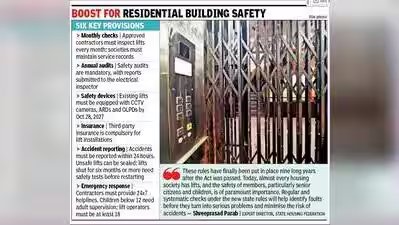
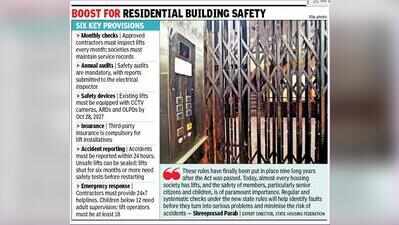
Pune: The state govt has notified new lift safety rules for housing societies, nine years after enacting Maharashtra Lifts, Escalators and Moving Walks Act in 2017. Effective Nov 1, Maharashtra Lifts, Escalators and Moving Walks Rules, 2026, make monthly servicing by approved contractors, annual safety audits and third-party insurance mandatory. Societies with existing lifts have until Oct 28, 2027, to upgrade them with CCTV cameras, automatic rescue devices (ARDs) and overload protection devices (OLPDs).Notified by the state energy department on Oct 28, the rules lay down standards for installation, operation, inspection and maintenance of lifts, escalators and moving walkways. Managing committees in housing societies will have to ensure monthly servicing by approved contractors, maintain inspection records and arrange annual safety audits.Citizen activists had been following up with the state govt to notify the rules following several lift accidents. MLA Siddharth Shirole had also raised the issue during the last assembly session.The need for stricter oversight has also come into focus following Tuesday’s incident in Nashik’s Satpur area, where a woman was injured after a lift plunged as she was stepping out on the fourth floor of a residential building. “The technical cause of the malfunction is yet to be established, but such incidents are being widely reported across the state,” an activist said.Advocate Shreeprasad Parab, expert director, state housing federation, told TOI, “These rules have finally been put in place nine long years after the Act was passed. Today, almost every housing society has lifts, and the safety of members, particularly senior citizens and children, is of paramount importance. Regular and systematic checks under the new state rules will help identify faults before they turn into serious problems and minimise the risk of accidents. The provisions will also make societies and maintenance contractors more accountable, ensuring that lift safety is not neglected or addressed only after an incident. This is a much-needed step towards making residential buildings safer.”Under the rules, owners or licence holders must ensure every lift, escalator and moving walkway is inspected and maintained at least once a month by an approved contractor. Contractors must maintain logs of inspections and work undertaken, while societies must monitor servicing schedules and ensure defects are rectified, electrical department officials said.Annual safety audits will be compulsory, with reports submitted to the electrical inspector. Third-party insurance will also be mandatory for lift installations. All newly installed lifts must have CCTV cameras and other safety devices. Explaining their purpose, an electrical department official said, “An ARD brings a lift to the nearest floor and opens its doors during a power failure, helping passengers avoid being stranded inside. An OLPD prevents the lift from operating when the permitted weight capacity has been exceeded. CCTV cameras provide footage of activity inside the lift and can help establish the sequence of events in the event of an accident or other incident.”Societies with older lifts will have to get them assessed by approved contractors and budget for the upgrades. “Costs will depend on the age and technical specifications of the equipment, which means societies will have to allocate a substantial budget towards maintenance,” a senior member of a housing society said on the new rules.The rules also empower the electrical inspector to stop the operation of unsafe installations and seal them if corrective measures are not taken. All accidents involving lifts, escalators or moving walkways must be reported to the inspector and local police within 24 hours. Installations that have remained non-operational for six months or more cannot be restarted without prescribed on-site tests by an approved contractor.Other safeguards include a ban on children below 12 using lifts or escalators without adult supervision and a minimum age of 18 for lift operators. “Contractors must also provide round-the-clock complaint and emergency call services. Those servicing more than 50 installations in a city, or installations located beyond 100 km from their headquarters, must establish an additional service centre in that area,” the rules stated.