








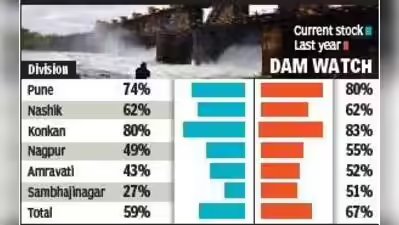
Pune: The collective storage in the state’s more than 3,000 major, medium and minor dams has more than doubled from a worrying 24% on July 1 to 59% on Monday, marking a significant improvement over the past four weeks in an El Niño year. Yet, the state remains short of last year’s mark, when reservoirs stood at 67%.According to data provided by the state irrigation department, western Maharashtra, particularly the Pune, Konkan and Nashik divisions, recorded the steepest gains, with swelling rivers and overflowing catchments breathing new life into reservoirs that were staring at a bleak start to the season.The picture is, however, far less reassuring in Marathwada and parts of Vidarbha. Chhatrapati Sambhajinagar division continues to be the state’s weakest link, with reservoir storage languishing at just 27%, the data showed. “Reservoirs in Konkan division are now 80% full, followed by Pune at 74% and Nashik at 62%. Storage in Nagpur and Amravati divisions has improved steadily through July but remains modest at 49% and 43%, respectively,” an irrigation department official said.Several of western Maharashtra’s key dams have witnessed a remarkable transformation over the past month. Ujani dam has surged to 97% capacity, while Koyna, the state’s largest reservoir, has climbed to 74%. Bhandardara and Gangapur dams are now at 91% and 85% live storage, respectively. Other major reservoirs, including Radhanagari and Dhom, have also benefited significantly from the monsoon bounty.The turnaround has been especially striking in Pune and Nashik divisions. Pune’s 35 major dams, which had dwindled to a precarious 11% storage at the beginning of July, have rebounded to 81%. Nashik’s 22 major reservoirs have seen storage jump by nearly 50 percentage points, rising from 23% on July 1 to 72% now.Officials said the coming weeks would be crucial. “We are closely monitoring reservoir levels. If the current rainfall pattern continues through Aug, many dams could reach full capacity. Vidarbha and Marathwada, however, still need substantial rainfall to improve their water situation,” another official said.The uneven spread of the monsoon remains evident. On the corresponding day last year, all six administrative divisions had reservoir storage above the 50%-mark, including Chhatrapati Sambhajinagar division. This year, despite the dramatic recovery in many regions, stark disparities in water availability continue to cast a shadow over parts of Maharashtra.