








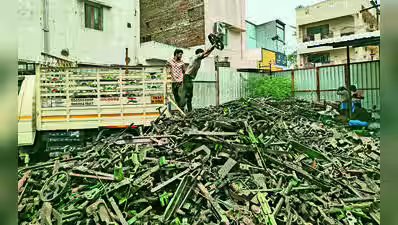
T he rhythmic ‘tak…tak’ of power looms which once defined the virtual heartbeat of Kumarapalayam and Pallipalayam in Namakkal district, has faded into a faint murmur today.For decades, weaving was not just an occupation but a way of life here. The looms fed generations and gave Kumarapalayam its identity. But rising yarn prices, soaring electricity bills, stagnant textile markets, and poor returns have pushed the industry into collapse.“We are forced to sell our looms as scrap iron. A loom worth `60,000 fetches barely `23,000 as junk. It breaks our hearts,” says T Saravanan, a second-generation weaver in Pallipalayam. The desperation has driven some to extremes. “I had no skill beyond weaving. To feed my family, I borrowed heavily. When debts crushed me, I had to sell my kidney a decade ago,” says A Arumugam.Weavers plead for urgent intervention. Tamil Nadu govt has introduced several welfare and support schemes for weavers in Erode district, ranging from free electricity supply to subsidies and continuous employment through state-sponsored production programmes, but the weaving industry continues to remain in a pathetic state. While schemes provide temporary relief, the long-term survival of the craft in Erode hangs in uncertainty.The textile industry plays a major role in Tamil Nadu. In 28 districts, handlooms, power looms, and automatic looms are being used to produce 3 crore meters of fabric every day. About 70% of these are located in Kongu region. But 80% of these fabrics are sent to northern states for value addition such as dyeing, bleaching, and printing.Erode and Namakkal districts are major centres for bleaching, dyeing, yarn dyeing, wet processing, screen printing, rotary printing, and finishing, serving as the direct source for textile hubs in Tirupur, Coimbatore, Karur, Salem, Namakkal, and Erode. When processing industries here are affected, the impact goes far beyond districts to fracture the textile value chain in TN.The Federation of Tamil Nadu Weavers Associations counts more than 350 member companies, anchoring about one lakh direct jobs and six lakh indirect jobs, summing up to a total livelihood dependency of about 7,00,000 people and their families spread across transportation, chemical distribution, engineering services, packaging, textile merchanting, and SMEs“When the chain breaks through processing delays, clothing production stalls, shipments are delayed, foreign orders are lost, employment suffers, and the state’s economic growth slows down,” says B Kandavel, general secretary of the federation.Recently, Tamil Nadu minister for handlooms, textiles and khadi, Vijay Balaji submitted a 20-point application to Union textiles minister Giriraj Singh.The proposals included financial assistance for a power loom park in Erode, a silk export trade facilitation centre in Kancheepuram, handloom development initiatives, technical textile export promotion support, wood carving support in Kallakurichi, and grants for international and national marketing events. “Union Minister Giriraj Singh assured that these appeals would receive due consideration,” minister Vijay Balaji said.