









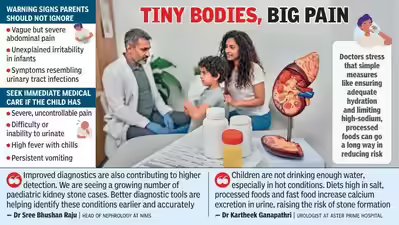
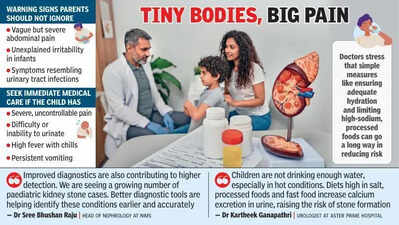
Hyderabad: What was once considered an adult health issue is now showing up in paediatric wards with worrying frequency. Doctors say kidney stones are increasingly being diagnosed in children, including infants marking a sharp shift from earlier decades when bladder stones linked to malnutrition were more common among children in Telangana.While improved nutrition has reduced bladder stone cases, a new mix of risk factors ranging from poor hydration and high-sodium diets to genetic and metabolic conditions is driving the rise in kidney stones among children. Specialists warn that if not detected early, the condition can lead to severe pain, infections and even long-term kidney damage.“There is a clear shift in trend,” said Mallikarjuna C, chief consultant urologist and managing director at Asian Institute of Nephrology and Urology. “Earlier, we mostly saw bladder stones in children, often linked to malnutrition. Now, we are diagnosing kidney stones even in one-year-olds. Genetic and metabolic factors play a major role.”He added that treatment in children requires precision. “Unlike adults, simple endoscopy may not be enough. These cases need specialised care. Extracorporeal Shock Wave Lithotripsy (ESWL) is a safe, non-invasive, first-line treatment, especially for stones smaller than 2 cm. Metabolic factors, such as increased calcium levels in urine, are also significant contributors,” he explained.Echoing the concern, Dr Kartheek Ganapathri, consultant urologist and andrologist at Aster Prime Hospital, pointed to a steady increase in cases. “We are seeing this more often now. I recently operated on a four-month-old, something extremely rare earlier,” he said.He highlighted dehydration and dietary habits as key triggers. “Children are not drinking enough water, especially in hot conditions. Diets high in salt, processed foods and fast food increase calcium excretion in urine, raising the risk of stone formation,” he added.Dr Sree Bhushan Raju, head of nephrology at Nizam’s Institute of Medical Sciences (NIMS), said improved diagnostics are also contributing to higher detection. “We are seeing a growing number of paediatric kidney stone cases in our rare diseases registry. We are even receiving queries from parents in neighbouring states like Karnataka. Better diagnostic tools are helping identify these conditions earlier and more accurately,” he noted.