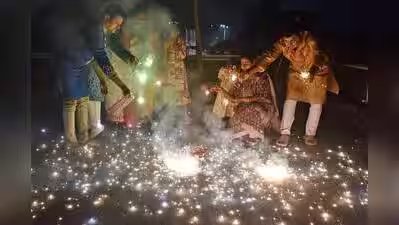







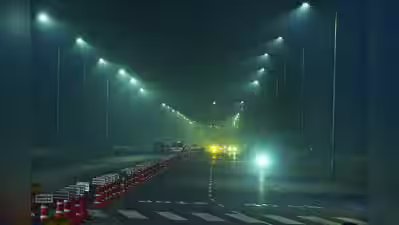
Kolkata: Kolkata’s ambient air quality deteriorated sharply on Kali Puja-Diwali Sunday night as rampant bursting of firecrackers pushed fine particulate pollution to hazardous levels across the city from 9 pm.The air quality decline was sharp. At 9 pm on Sunday, all the seven air quality monitoring stations in Kolkata reported “moderate” air quality with Ballygunge and Jadavpur already inching towards “poor”. Central Pollution Control Board (CPCB) data showed that after recovering in the afternoon, the parameters — mainly PM2.5 and PM10 — started deteriorating again after 6 pm on Sunday. Residents said a burning smell filled the air in many places, and a haze had enveloped their neighbourhoods from the smoke emitted by crackers.The city’s air had already plummeted the previous night, when widespread crackers bursting on Diwali eve sent several Continuous Ambient Air Quality Monitoring Stations into the dark-red “very poor” category between 9 pm on Saturday and 2 am on Sunday. The PM2.5 sub-index crossed 300 at Ballygunge, Salt Lake and Jadavpur, exposing residents to dangerously polluted air.Apart from deafening high-decibel firecrackers, environmentalists said non-green fireworks containing banned substances such as barium and barium salts, lead, mercury compounds, arsenic, antimony and lithium were widely used, leaving the air extremely hazardous, especially for kids, the elderly and those with respiratory ailments.The deterioration was particularly alarming because Kali Puja falls unusually late this year, with a wintry chill already setting in. Environmentalists warned that falling night-time temperatures and atmospheric temperature inversions could trap toxic pollutants close to the ground and prolong their impact well beyond the period of bursting.Hourly pollution data captured the scale of the spike. At Salt Lake, the PM2.5 sub-index jumped from 117 at 4 pm on Saturday to 330 by 11 pm, before peaking at 336 at 1 am. Ballygunge recorded a rise from 148 at 4 pm to 321 at 11 pm, while Jadavpur climbed from 159 to 326 during the same period.The spike was not limited to these three stations. Fort William’s PM2.5 sub-index rose from 120 at 4 pm to 268 at 1 am, while Rabindra Bharati University on BT Road recorded 265. Victoria Memorial, which had a comparatively cleaner afternoon with a reading of 104, deteriorated to 233 by 3 am.Although pollution levels began declining before dawn at several monitoring stations, readings remained elevated at 5 am, indicating that the pollutant load had not fully dispersed.The primary concern was PM2.5. These particles can penetrate deep into the lungs, and some can enter the bloodstream, carrying toxic substances linked to firecracker emissions, including heavy metals and combustion by-products.Environmental activist Subhas Datta blamed both poor enforcement and lack of civic responsibility for the violations. “It is our failure as environmentalists that we could not make people understand that they should not violate the norms,” Datta said. He also held the administration responsible for failing to prevent violations.Environmentalist Somendranath Ghosh warned that the impact of cracker pollution could outlast the celebrations. Naba Dutta of Sabuj Mancha questioned the unchecked sale of illegal crackers in local markets ahead of the festivities. “The PCB said in its meeting with housing complexes that crackers sold in Bazi Bazaars were the only legal ones. But across the city, one can find illegal crackers being sold,” he said.Activists said limiting the use of green crackers to the prescribed two-hour window would achieve little unless authorities acted against illegal sales and bursting.