









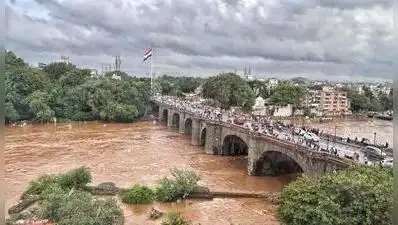
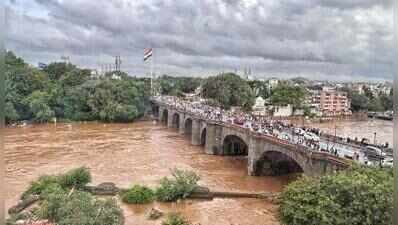
Pune: Heavy rainfall across catchment areas of the district pushed water storage levels in key reservoirs close to maximum capacity, with the collective usable water storage of four dams in Khadakwasla cluster reaching 28.89 TMC (99.1% of total live capacity) as of Sunday morning.According to the official report of the irrigation department, active monsoon spells have generated steady inflows into dams. Within Khadakwasla cluster, Khadakwasla dam remains at 100% live capacity, holding 1.97 thousand million cubic feet (TMC) of usable water after receiving 7mm of rain in the previous 24 hours ending on Sunday morning.Panshet dam reached 100% capacity, with 10.65 TMC of useful water storage after its catchment area recorded 68mm of rainfall on Sunday. Varasgaon dam, the largest reservoir in the cluster, is also at 100% capacity, holding 12.82 TMC of usable water following 66mm of fresh precipitation. Temghar dam’s storage has risen to 3.44 TMC, representing 92.8% of its capacity, while recording the cluster’s highest daily rainfall at 86mm.Outside the core cluster, Bhama Askhed dam, a crucial water source for northern Pune and Pimpri Chinchwad, holds usable storage of 7.56 TMC, reaching 98.58% of its total capacity after receiving 16mm of rainfall on Sunday.Sunday’s water quota was higher than last year on the same day. The collective storage was 25.65 TMC in 2025, which was 87.97% of the total capacity.As per the irrigation department, the water discharge from Khadakwasla dam was increased on Sunday morning as well as in the afternoon. Owing to continuous heavy rainfall across the catchment area driving a rapid rise in reservoir storage at Khadakwasla dam on Sunday, the Khadakwasla irrigation division stepped up water release into Mutha river in phases. The discharge rate was initially increased to 20,779 cusec at 10am and then to 24,277 cusec by 2pm.Irrigation officials urged residents in low-lying areas to stay alert, strictly avoid stepping into the riverbed, and immediately moving livestock and personal equipment to higher ground. “Discharge rates will continue to be regulated based on fresh inflows and weather conditions. They may go up if rainfall increases,” said a senior official of the department.Following heavy monsoon spells across catchment areas of Pune and Solapur districts, major dams outside the core Khadakwasla system also recorded near-full storage levels on Sunday morning. Pavana dam reached 98.6% of live capacity (8.39 TMC) following 54mm of rainfall, while Andra dam crossed full capacity at 100.01% (2.92 TMC) with a spillway discharge of 1,353 cusec.In Mula basin, Tata Power’s Mulshi dam received 150mm of fresh precipitation, taking its storage to 88.3% (17.80 TMC) and prompting a controlled spillway release of 6,000 cusec. Downstream in Solapur district, the massive Ujani dam reached 97.5% of its live usable capacity (52.27 TMC). Due to huge cumulative inflows from upstream reservoirs, irrigation officials initiated a major spillway discharge of 90,000 cusec into Bhima river.