









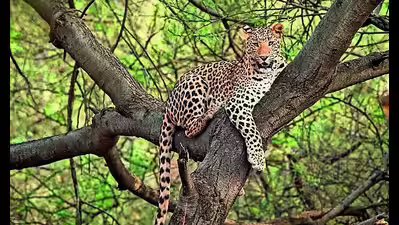
New Delhi: A 10-year management plan for Asola Bhatti Wildlife Sanctuary, drawn up by Wildlife Institute of India (WII), has documented the presence of 23 mammal species, including leopards, striped hyenas, common palm civets and golden jackals, within the sanctuary.The plan proposes the designation of 9 sq km as core zone and 7.6 sq km as tourist zone. It recommends fixing the sanctuary’s ‘carrying capacity’ on the number of visitors to maintain an ecological balance.Using 23 camera traps, WII recorded 18 wild and five stray or domestic mammal species. “Rhesus macaques, nilgais and golden jackals were most frequently captured on the camera traps, showing wide habitat tolerance. Rare detections included leopards, striped hyenas, common palm civets and sambars, indicating their low densities and restricted distribution,” WII, an autonomous institution of the Union ministry of environment and forests, states.The presence of predators like leopards and hyenas was mostly recorded in the less-disturbed patches, while herbivores, such as nilgai and chital, were widespread across open scrub and plantation zones.Camera-trap data also revealed that stray cattle were widely distributed across the sanctuary, making them the second-most abundant mammal group after rhesus macaques. Four main types of livestock were recorded, with cows being the most common (7%), buffaloes (4%), pigs (0.6%) and camels (0.4%). Other species sighted include ruddy mongooses, Indian boars, Indian hares and Indian crested porcupines.The plan, which is set to remain in force till 2034-35, recommends scientific assessments to estimate the rhesus macaque population, phasing out of artificial feeding and implementation of scientifically managed sterilisation for sustainable management of wildlife population.It emphasises the proposed division of the sanctuary into five zones based on carnivore movement patterns, ecological restoration requirements, tourism activities and the complexities of managing urban fringes.The core zone, ecologically the most sensitive area, will serve as a critical wildlife habitat. “Our study documented active leopard and jackal movement in some stretches, with minimal signs of human disturbance, making these suitable to be designated as the core zone of the sanctuary. The area extends from Neeli Jheel through the abandoned Bhatti mines to below Bhatti village and functions as a key carnivore corridor linking directly with Haryana’s forests,” according to the Dehradun-based institute.Spanning around 24 sq km, the conservation zone will act as a buffer to the core area. “It will act as a crucial stretch for habitat restoration, species protection and long-term ecological monitoring,” the plan states.The tourism zone, overlapping the core and conservation areas, will extend from the main entrance to Neeli Jheel. “This stretch will combine structured nature education programmes with designated tourism sites, providing visitors with opportunities for awareness, learning and low-impact recreation,” it adds.The sanctuary recorded a footfall of 33,897 in 2023-24 and 26,954 in 2024-25. “An assessment will be conducted, and only a limited number of tourists will be permitted per day beyond certain points. This will minimise disturbance to wildlife while offering meaningful experiences,” WII states.It has proposed a 5-sq km interpretation-cum-education zone, including areas designed for visitor engagement, learning and nature-based recreation. It will include the butterfly garden, Aravalli Forest Park, souvenir shop, ticket centre, nurseries, cycle track, nature education centre and jungle trails.A 12.1 sq km extended buffer zone will encompass several small, relatively unmanaged forest patches that are currently outside the sanctuary boundaries. “Despite their fragmented condition, these patches hold critical ecological significance. With many water bodies, they can serve as potential corridors for carnivore movement and link the sanctuary with adjoining forests in Delhi and Haryana, as well as forested stretches toward Tughlaqabad,” according to WII.