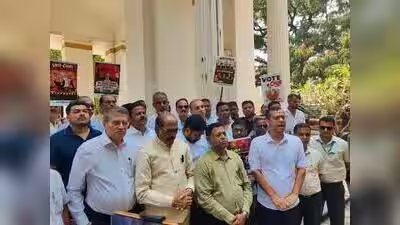








Margao: The Joint Parliamentary Committee (JPC) examining the ‘One Nation, One Election’ bills on Saturday said simultaneous elections, once implemented, would be introduced in phases, with assemblies whose terms end before the common election cycle serving truncated tenures to bring them in sync.Addressing reporters after two days of consultations in Goa, JPC chairman P P Chaudhary explained that once an “appointed day” is fixed after the law comes into force, assemblies due for elections in the intervening years — for instance, between 2030 and 2033 — would be aligned with the next common election cycle, currently envisaged for 2034. Any assembly constituted mid-cycle because of premature dissolution or President’s Rule would serve only the remainder of that cycle rather than a fresh five-year term.“If they know that after going to elections they may get only a one-year or two-year period, that possibility itself reduces instability,” Chaudhary said, describing the arrangement as a built-in deterrent against premature dissolutions.On anti-defection safeguards, repeatedly flagged by civil society groups during the hearings, Chaudhary said the committee could recommend strengthening the law even though it falls outside the bills’ direct scope. He added that the panel was also considering a German-style “constructive vote of no-confidence”, under which a no-confidence motion would have to be accompanied by a simultaneous vote naming an alternative leader.Chaudhary said the Goa consultations received “overwhelming support” for the proposal from legislators, officials, industry representatives, academics, legal experts and civil society groups. He said synchronised elections could save the economy nearly Rs 7 lakh crore, adding that tourism-dependent states such as Goa were particularly affected when elections coincided with the peak tourist season.Rejecting concerns that simultaneous elections would undermine federalism, Chaudhary cited the four general elections held alongside Lok Sabha polls between 1952 and 1967. He said six former Chief Justices of India and several sitting and former Supreme Court judges had informed the committee that the proposed framework did not violate the Constitution’s basic structure.The committee has completed consultations in Maharashtra, Uttarakhand, Punjab, Himachal Pradesh, Haryana, Karnataka, Gujarat and Goa. Its next visit will be to Uttar Pradesh.