







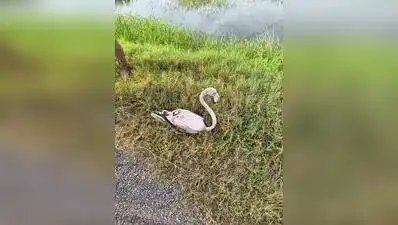
Gurgaon: A greater flamingo with both legs broken and its skin injured was rescued on Sunday from Chandu after it was suspected to have collided with a high-tension electricity wire. The bird was found struggling on the ground by birder Rakesh Ahlawat, who rescued it and arranged for its transfer to Sultanpur National Park, where it is now undergoing treatment.“Both its legs were broken and its skin was damaged. I saw it and immediately went into the water to rescue it. It is very badly injured and may never be able to fly again,” Ahlawat told TOI.The forest department has taken charge of the bird’s treatment, with veterinary teams assessing its condition and providing medical care under observation.Officials said the flamingo may have collided with high-tension wires, an incident that has again raised concerns over the risks power lines pose to migratory birds around the Najafgarh wetland and Chandu area.The area has recorded several such incidents in recent years. A flamingo was injured in a similar collision on Feb 3, 2023, while another greater flamingo with comparable injuries died after being rescued from Najafgarh wetland on Nov 28. A northern pintail was hurt after hitting wires on Oct 30, and a bar-headed goose was left unable to fly following a similar accident on Oct 23, 2022. In January 2021, an injured ruddy shelduck had to be rescued as well.Bird experts have called for measures to prevent such collisions, particularly during the winter migration season when Najafgarh wetland attracts large numbers of waterbirds.“The govt can install reflectors to avoid such incidents,” said Pankaj Gupta, a bird expert from Delhi Bird Society, adding that the wetland also needs to be protected as a habitat for migratory birds.“The region usually witnesses several migratory birds from across the Central Asian Republics of Kazakhstan, Iran, China, Mongolia, Nepal and Bhutan. These birds are mostly wetland inhabitants, and we need to protect their habitat,” he said.Najafgarh wetland and its surrounding areas receive several migratory species every winter, including greater flamingos that use the area for roosting. Birders and conservationists have sought measures to make the power infrastructure around the wetland safer for birds. Officials have also urged residents to report injured or distressed wildlife promptly.Main changes: dropped the redundant opening blurb (it repeated the full story verbatim), fixed “might not able to fly” → “may never be able to fly again,” smoothed the quote attribution, converted the incident list into readable prose instead of a choppy date-by-date list, and tightened transitions throughout.