







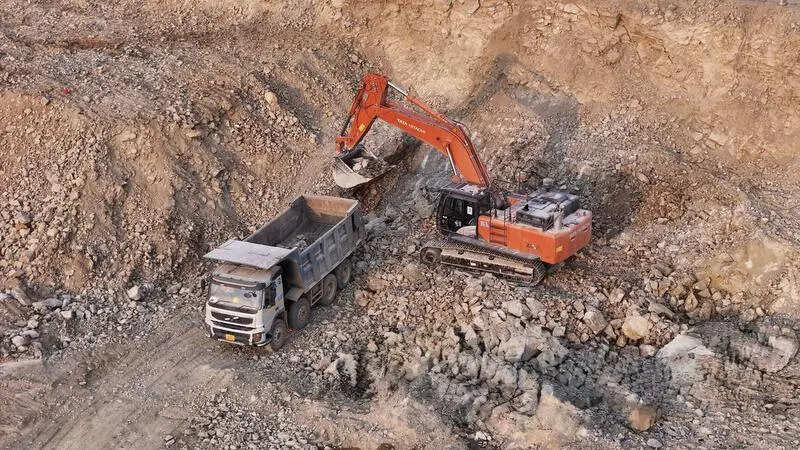
Kurnool: From the time of Emperor Ashoka to the renewed push for an Aatmanirbhar Bharat, India’s enduring love affair with and fascination for the precious yellow metal has been both cultural and economic. Now, in the parched, mineral-rich terrain of Andhra Pradesh‘s Kurnool district, a centuries-long dormant ambition is finally turning into reality.Jonnagiri: All that glittersThe processing plant of Geomysore Services India Pvt Ltd’s Jonnagiri gold project, India’s first large-scale private gold mine since Independence, is all set to go live in the first week of May. Hectic activity can be witnessed at the plant as it goes through the pre-commercial operations process with the management closely monitoring the run-up to full-fledged production.Heavy dependence on importsFor decades, India’s gold quest has been defined by dependence. The country imports over 800 tonnes of gold every year, which puts sustained pressure on foreign exchange reserves.Domestic production, meanwhile, has remained limited. The state-run Hutti Gold Mines continues to be the only significant producer, yielding roughly 1.5 tonnes annually, while the iconic Kolar Gold Fields ceased operations in 2000, leaving a void in large-scale gold mining.Public sector enterprises like Navratna miner NMDC Ltd too have diversified into gold mining but that has been done by acquiring mining companies and mines abroad. It has been mining at the high-grade Mt Celia gold project that is operated by its subsidiary Legacy Iron Ore Ltd to tap the key deposits at Blue Peter and Kangaroo Bore and was successful in producing the first ore in early 2024.India’s first private sector gold mineBut the Jonnagiri gold project, which is spread across nearly 598 hectares in Jonnagiri, Erragudi and Pagidirayi villages of Kurnool, represents a major private sector foray into gold mining in India. Geomysore Services, which is backed by Thriveni Earthmovers & Infra, one of India’s largest mine developers and operators and Deccan Gold, is a BSE listed company. The keenly watched project has already attracted an investment of over ₹400 crore.Andhra Pradesh chief minister Chandrababu Naidu is expected to dedicate the project to the nation in early May. “This is a landmark moment —not just for Andhra Pradesh, but also for India’s broader (gold) mining ambitions,” said Mukesh Kumar Meena, principal secretary, mines and geology, Andhra Pradesh.Project on fast trackThe processing plant was commissioned in 13 months. “Jonnagiri reflects what India is capable of when vision, technology and execution come together. We are not just building a mine, but creating a model for responsible, efficient and globally competitive mining in the country,” said B Prabhakaran, founder and managing director of Thriveni Earthmovers.The project is backed by robust resource estimates. The certified resources stand at 13.1 tonnes of gold, with exploration indicating a potential upside of up to 42.5 tonnes.At peak capacity, the mine is expected to produce up to 1,000 kg of refined gold annually over the next 15 years.Project sparks hope of golden mining future“Success of this project should encourage many investors to come into the gold and critical mineral sector, which is the need of the hour for India, both commercially and strategically,” said Dr Hanuma Prasad Modali, director of Geomysore and managing director of Deccan Gold.He pointed out that several untapped gold and critical mineral deposits across the country could be brought into production with sustained exploration. “India should aim at producing at least 50 to 100 tonnes of gold per annum in the next decade.” Deccan Gold is also developing a gold mine in Kyrgyzstan and exploring resources including copper, nickel, lithium and tungsten in India and abroad.Jonnagiri is also being positioned as a socially integrated project with initiatives spanning education, healthcare, sanitation, drinking water and skill development in surrounding villages. This emphasis on what industry experts term a “social licence to operate” has helped the project gain acceptance among local communities.The Chandrababu Naidu led-NDA govt has played a facilitating role, aligning the project with its industrial development goals and supporting clearances.Experts say that the project may not immediately transform India’s gold import bill, but it marks a structural shift — signalling that the country is once again ready to tap into its own mineral wealth.From rocks to richesBefore dawn breaks over the rugged stretches of Kurnool, silence at the Jonnagiri gold fields steadily gives way to a rising mechanical symphony—drills piercing the earth, controlled blasts cracking ancient rock, and giant excavators clawing through layers that have guarded their secrets for millennia.What unfolds here is nothing short of modern-day alchemy, where ordinary stone is coaxed, crushed, and transformed into gold.At the Geomysore Services gold project in Jonnagiri, the process begins with open-pit mining.Precision drilling and controlled blasting break down hard rock formations, exposing gold-bearing ore.Massive dumpers then transport the mined material to the processing plant, where it undergoes systematic crushing and grinding into fine particles. This powdered ore is first subjected to gravity separation, enabling early recovery of coarse gold.The finer material then enters the carbon-in-leach system, a critical stage where a cyanide solution dissolves the remaining gold.The dissolved metal is adsorbed onto activated carbon, setting the stage for extraction. Through elution and electro-winning, the gold is separated and collected as a dense sludge.In the final stage, intense heat within smelting furnaces transforms this residue into doré bars—solid, gleaming proof of a remarkable journey from rock to riches.