









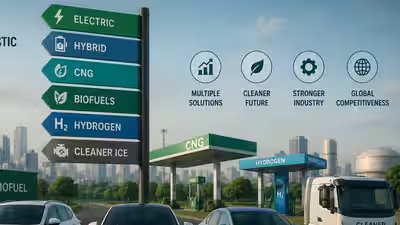
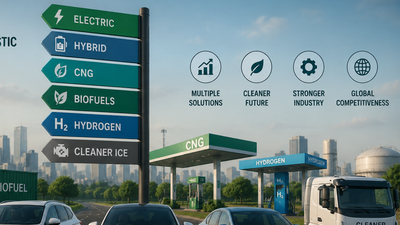
MUMBAI: India’s transition to cleaner mobility is expected to follow a technology-agnostic path rather than an exclusively electric vehicle (EV)-led route, with industry experts and policy think tanks indicating that EVs, hybrids, compressed natural gas (CNG), biofuels, hydrogen and cleaner internal combustion engine (ICE) technologies will coexist over the coming decade.The evolving approach is also expected to reshape India’s automotive component industry, creating opportunities for manufacturers to diversify product portfolios while strengthening the country’s position as a global automotive manufacturing hub.According to the International Energy Agency’s (IEA) Global EV Outlook 2026, India continues to be among the world’s fastest-growing EV markets, driven largely by electric two- and three-wheelers. Annual EV sales have crossed 2.4 million units. However, EVs still account for only a small share of the country’s overall vehicle fleet, highlighting the continued role of conventional and alternative powertrains during the transition.The outlook is broadly in line with NITI Aayog’s advocacy of a technology-neutral strategy for decarbonising transport. The policy think tank has argued that India’s diverse geography, varying income levels, different vehicle usage patterns and uneven charging infrastructure require multiple clean mobility solutions rather than reliance on a single technology.For consumers, the multi-technology approach could translate into a wider choice of cleaner vehicles suited to different needs, while allowing the supporting infrastructure—including charging stations, CNG networks and alternative fuel ecosystems—to expand in phases.The transition is also opening new avenues for India’s automotive component industry. According to the Automotive Component Manufacturers Association of India (ACMA), the sector has grown into a USD 75-billion industry, contributing nearly 2.3% to the country’s GDP. Component exports have also risen steadily as global automakers diversify sourcing under the China-plus-one strategy, positioning India as an increasingly important manufacturing base.Industry experts said the next phase of growth will depend not merely on higher production volumes but on technological capabilities. Manufacturers are expected to develop components simultaneously for advanced ICE engines, hybrid vehicles and electric drivetrains while investing in electronics, embedded software, sensors, lightweight materials and precision engineering.They added that research and development, artificial intelligence, automation and digital manufacturing will increasingly determine competitiveness as the industry moves from conventional mechanical engineering towards software-enabled mobility solutions.“India’s automotive industry is undergoing its biggest transformation in decades. While electrification has become the defining global narrative, India’s transition to cleaner mobility will be far more nuanced than simply replacing internal combustion engine vehicles with electric vehicles,” said Adithya Jayakar, deputy managing director of UCAL Ltd.Industry observers also pointed to supply-chain resilience as a strategic priority after the Covid-19 pandemic and geopolitical disruptions exposed India’s dependence on imported electronics, semiconductors and specialised materials. While the Centre’s Production Linked Incentive (PLI) Scheme has accelerated investments in domestic manufacturing, they said deeper localisation of high-value components would be crucial for improving export competitiveness and reducing import dependence.Sustainability is also emerging as a key business imperative beyond regulatory compliance. Renewable energy use, circular manufacturing, responsible sourcing and carbon disclosure are increasingly influencing procurement decisions by global original equipment manufacturers (OEMs), prompting Indian suppliers to align with international sustainability benchmarks.Jayakar said policy support should encourage innovation across the mobility ecosystem rather than favour any single propulsion technology.“India’s competitive advantage lies in its ability to innovate across technologies, not in choosing one over another. As the country aspires to become a global automotive manufacturing hub, success will depend on building capabilities across the entire mobility spectrum,” he said.