










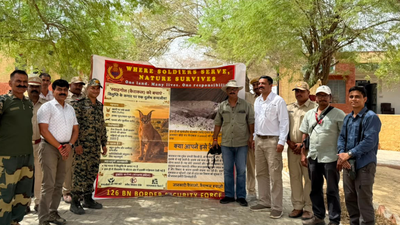
JAISALMER: Chairman of the Wildlife Institute of India (WII), Govind Sagar Bhardwaj, has announced that the 6th cycle of the All India Tiger Estimation (AITE) 2026, regarded as the world’s largest wildlife monitoring exercise, has commenced and will continue through 2027. The final assessment report is expected to be released in 2027.Speaking during his three-day visit to Jaisalmer on Thursday, Bhardwaj said that the latest tiger census is not limited to counting tigers but also includes a comprehensive scientific assessment of their co-predators, prey base, habitats, and the overall forest ecosystem.He further revealed that the Ministry of Environment, Forest and Climate Change has launched the ‘Tiger Outside Tiger Reserve’ (TOTR) project to strengthen the protection of tigers living beyond notified tiger reserves and to reduce human-wildlife conflict.“Nearly 30 percent of India’s tiger population currently lives outside notified tiger reserves. Under the TOTR initiative, states where tigers occur outside reserve boundaries are receiving financial as well as technical assistance. The project supports monitoring of these tigers, tranquilizing and rescuing animals entering human settlements, preventing conflicts arising from livestock depredation, and developing safe wildlife corridors,” Bhardwaj said.Funding under the programme is being provided through the National Compensatory Afforestation Fund Management and Planning Authority (CAMPA) to around 80 forest divisions across 10 states, where tigers inhabit territorial forests and other landscapes outside protected reserves.Bhardwaj recalled that Project Tiger was launched on April 1, 1973, by the Ministry of Environment, Forest and Climate Change, with the National Tiger Conservation Authority (NTCA) serving as the nodal agency.“India currently has 58 Tiger Reserves spread across nearly 84,500 square kilometres,” he said.Highlighting India’s global leadership in big cat conservation, Bhardwaj said the country is home to nearly 70 percent of the world’s wild tiger population, making it the global leader in tiger conservation.He also spoke about the International Big Cat Alliance (IBCA), a global coalition of 95 big cat range countries and partner organisations, established with India’s leadership. The alliance promotes international cooperation for the conservation of the world’s seven major big cat species—Tiger, Lion, Leopard, Snow Leopard, Cheetah, Jaguar, and Puma. The IBCA Secretariat is based in India and aims to strengthen collaborative conservation efforts worldwide.Referring to the ongoing tiger estimation exercise, Bhardwaj said data collected from all participating states will undergo detailed scientific analysis before the final report is released in 2027.He noted that the Wildlife Institute of India is actively engaged in the conservation, recovery, and ecological monitoring of several endangered species, including the Tiger, Asian Elephant, Snow Leopard, Asiatic Lion, One-horned Rhinoceros, Gharial, Ganges River Dolphin, and Vultures.Discussing the conservation of the Caracal, a Schedule I protected species recently confirmed in the desert landscape of Jaisalmer, Bhardwaj said WII and the Rajasthan Forest Department initiated intensive monitoring after the first confirmed sighting.“Following confirmation of one Caracal, we installed four camera traps, which subsequently recorded the movement of three to four additional Caracals in the area. WII and the Rajasthan Forest Department are jointly monitoring these animals,” he said.Bhardwaj added that WII has prepared a comprehensive Caracal conservation project and action plan, which has been submitted to the Rajasthan Government. The proposal includes a scientific population assessment (census), long-term monitoring, and habitat conservation measures aimed at ensuring the survival of the elusive desert cat in Rajasthan.