







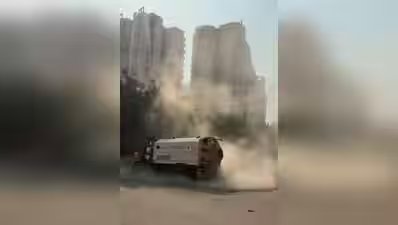
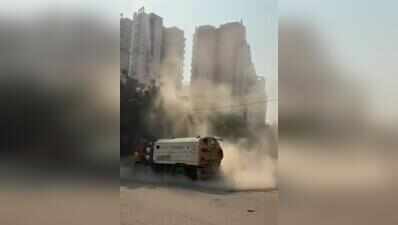
Noida: The Greater Noida Industrial Development Authority (GNIDA) on Thursday imposed a fine of Rs 1 lakh each on two companies responsible for mechanical road sweeping following complaints that their machines were generating dust while cleaning roads in Greater Noida West.A video posted on X on Wednesday shows a mechanical road-sweeping machine kicking up a huge cloud of dust while cleaning a road, raising concerns over pollution-control measures. The machine was sweeping the road without spraying water to settle the dust first, causing thick clouds to engulf the area and reduce visibility.Mohit Rana, an X user, posted the video with the caption: “Breaking news: Greater Noida Authority workers checking pollution with pollution near Manthan School in Greater Noida West.”The 12-second clip garnered 35,000 views in a day. The incident has raised questions about the effectiveness of Greater Noida’s mechanised road-cleaning drive, particularly at a time when pollution levels remain a major concern.Several users posted on social media, pointing out how this violated Graded Response Action Plan (GRAP) norms applicable across Delhi-NCR. One user even said he had spotted a mechanical sweeping machine in Greater Noida West for the first time, but it appeared to be defeating the very purpose of its deployment.GNIDA officials said that a preliminary inquiry found that dust was billowing behind the machines during road cleaning because water was not being sprayed on the roads before sweeping.In Greater Noida, mechanical sweeping and waste management are handled by Antony Waste Handling Cell and Yaduvanshi Infrastructure, which together deploy eight machines and cover nearly 300-400 km of roads daily.GNIDA CEO Balkar Singh said the Authority has issued notices to both firms, seeking their replies within three days. “We have imposed a fine of Rs 1 lakh each on the two companies. We have also warned that they could be blacklisted if their responses are not satisfactory,” the CEO said, adding that the fines will be deducted from the companies’ bills for the coming month.Manish Kumar, a resident of Supertech Eco Village 1, said mechanical sweeping machines largely covered wider roads, such as the 130-m and 60-m stretches. Their operations in Greater Noida West remain irregular and limited to select areas.“As a result, roads around Gaur City, Supertech Eco Village and other high-rise societies remain dusty,” Kumar said. “The machines usually clean the stretches along the central verge, leaving the left side of the roads unattended. In many cases, they also operate without sprinkling water, causing dust to rise and worsening pollution.”Kumar also called for action against Authority supervisors responsible for monitoring sanitation work in their respective areas, alleging that they had failed to ensure proper implementation.GNIDA deputy general manager Vijay Rawal said they held a meeting following the incident to address the lapses. “We will ensure that mechanical sweeping machines operate only after water is sprinkled on the roads. The Authority will arrange treated water from sewage treatment plants (STPs) for this purpose,” Rawal said.He said that the primary investigation found that these machines are equipped with sprinklers. “However, when the road dust is high, the sprinklers fail to yield desired results. In this situation, we will sprinkle additional water using tankers on the road,” he said.Officials said they are also identifying dust- and garbage-vulnerable points across Greater Noida and Greater Noida West and will undertake a special deep-cleaning drive. The Authority currently has 14 mechanical sweeping machines and plans to add 14 more by Jan 2027.On Thursday, Noida (AQI 243), Greater Noida (AQI 266) and Ghaziabad (AQI 232) all recorded air quality in the ‘poor’ category.Greater Noida is spread over 380 sq km and comprises 95 sectors and 124 villages, divided into eight administrative zones known as work circles. As per the 2011 Census, the city’s population was around one lakh, which has since grown to an estimated 10 lakh.