







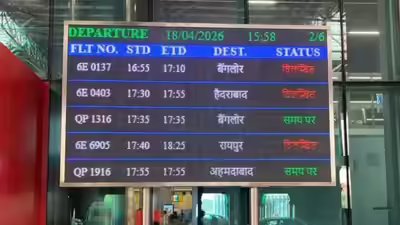
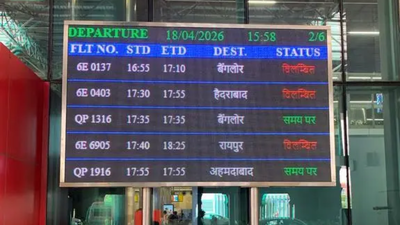
PUNE: The Indian Air Force on Saturday constituted a court of inquiry to determine the exact cause behind the hard landing of the Sukhoi-30MKI fighter jet on Friday night at Pune airport, prompting the runway closure for about 10 hours.The Indian Air Force (IAF) spokesperson, Wing Commander Jaideep Singh, confirmed the development.Another senior IAF officer said the court of inquiry would investigate multiple factors, including the oleo-pneumatic system, vertical speed of the aircraft during landing and the pilots’ response. “Usually, multiple factors are responsible for a heavy (hard) landing of any fighter jet. So, it is extremely difficult to pinpoint the cause at this stage. The technical team will examine each system thoroughly to identify any technical error in the aircraft. One of the crucial elements is the oleo-pneumatic system. It helps ascertain the landing impact,” the officer, speaking on the condition of anonymity, said,“There has to be a specific vertical speed limit for the aircraft while landing. Exceeding the permissible limit can result in a heavy landing. This element would be checked. Additionally, the height at which the pilot first spotted or visualised the runway before landing would be examined. Likewise, the inquiry panel will investigate multiple factors,” he said.Another reason behind establishing the court of inquiry is to assess the physical damage to the aircraft. “The damage needs to be repaired, and for that we require a budget. Allocation of budget mandates an inquiry report. Hence, the panel will also investigate this aspect,” said another IAF officer.According to standard operating procedures, after such incidents, the aircraft is towed away and examined thoroughly by the technical team. “A detailed technical inspection of the aircraft will be carried out. Further action will be decided based on it,” IAF sources added.IAF officials at the Air Force Station (AFS), Pune, said airmen worked expeditiously overnight in a coordinated effort to clear the runway at the earliest and restore the safety of flying operations. “We utilised our specialist expertise and indigenous mechanical resources to achieve full normalcy within a highly compressed time frame despite the challenging conditions and time constraints. The airport is now operating civil flights again at full capacity,” an IAF officer said.It took close to 10 hours to operationalise the runway. “The entire operation was conducted at night and was, therefore, time-consuming. We had to meet high procedural standards. Safety is paramount for us, and we cannot grant clearance merely because civil flight operations were disrupted,” an IAF official said.The technical team had to carry out a thorough inspection of the entire 3km runway to remove foreign objects such as nuts, bolts or any other debris, IAF sources said. “There is a possibility of aircraft components breaking off because of such landings. If any such part remains on the runway, it can affect subsequent flight operations,” the sources said.The collected samples of foreign objects are examined by the technical team to ascertain their source. The senior air traffic control officer and the chief operations officer (COO) then give clearance to resume flying operations.