











By: Sakshat.tornekarHyderabad: It is built not to hover, but to hunt. Defence technology startup Apollyon Dynamics’ electric multirotor interceptor Ahuti Mk II has entered the India Book of Records after clocking 498 kmph, making it the fastest multirotor UAV recorded in India, according to the company incubated at BITS Pilani Hyderabad.The startup said the speed was more than 170 kmph higher than the roughly 325 kmph figure it cited as the previous fastest recorded speed for a drone in India.Apollyon founder Jayant Khatri said the interceptor underwent extensive redesign to achieve the feat. “Ahuti Mk II was redesigned around the requirements of a high-speed interceptor, with about 10 iterations of its frame, propulsion and motor configuration,” he said.
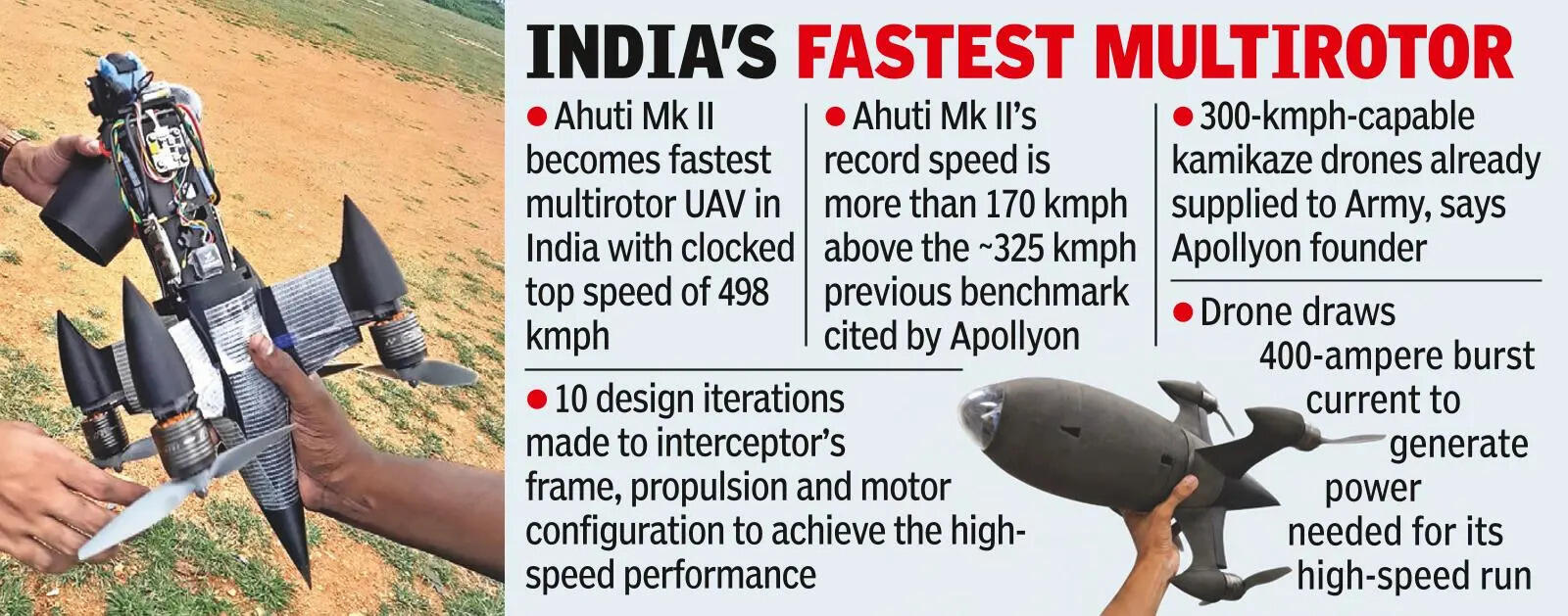
“We had already supplied our kamikaze drones to the Indian Army at 300 kmph. From Dec to Aug, we worked to achieve this speed,” Khatri added. Unlike conventional multirotors designed primarily for stability, hovering and carrying payloads, Ahuti Mk II is intended to rapidly close the distance with an incoming aerial threat. Khatri said the changing nature of drone warfare, including the use of low-cost Shahed-class drones in recent conflicts, was one factor behind the focus on speed.“We are using 400 amperes at once. It’s a burst current of 400 amperes, which is giving us the speed,” he said.Apollyon has tested its systems at military firing and operational ranges, including Babina and Gopalpur. Khatri credited the Indian Army’s cooperation for enabling the trials.Beyond the speed record, the startup said its focus is on making counter-drone systems economically viable. It uses “strike envelope per rupee” as an internal metric to assess the capability delivered for the cost involved.“We want to provide the biggest bang for the buck,” Khatri said, with “bang” referring to lethality.The founders said the company also has a longer-term ambition to develop a large cruise-missile platform capable of carrying thousands of kilograms of explosives by 2032. Professor M Rama Manohara Babu, former programme director for the Agni missile, is on the company’s advisory board, they added.