










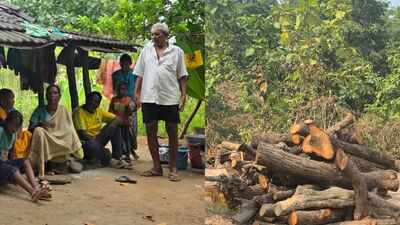
Villagers at the foot of Saidongar in Karjat heard it before they saw it: chainsaws whirring in the forest above their homes. When they climbed up on Oct 21, they found 400 to 500 trees felled for a proposed pumped-storage project where guards had cordoned off the site.Felling continued for four days before protests halted it. The trees were among 32,490 marked for removal for a 3,000MW project by Torrent Power. Families and activists living in and around the forest, however, say the stakes cannot be measured in hectares or megawatts.A 20-minute walk from the foothills, along a rough trail and across a river—all of it now under tight police cover—leads to five huts where three families, 16 people in all, live. There is no electricity or regular water supply. Yet Shivaji Shankar Pawar (61) calls it home. “We cannot imagine leaving this place,” he says.Torrent representatives visited around May, Pawar recalls, took down details and measured land. They discussed payment for jackfruit and guava trees but never explained where families might be relocated or gave them anything in writing.Karjat divisional forest officer (DFO) Sameer Shinde disputes this account. “No one lives on the forest land at Saidongar,” he says, though TOI met families living there. Compensation and rehabilitation, he adds, are the revenue department’s responsibility.Beyond the ecological impact, this gap in responsibility lies at the heart of the villagers’ complaint: the project has moved faster than consultation with people it affects.The project requires 233 hectares of forest land and 144 hectares of village land (see map), about 15-16km from Bhimashankar Wildlife Sanctuary. But residents say they do not know whose land will be acquired. Kondu Laxman Kharat has been told verbally his house lies outside the project area, but survey pillars have come right behind his home.Prasad Deshmukh, who is leading Pali-Saidongar Gram Sabha’s opposition, says Maharashtra Pollution Control Board held a hearing on Sept 3, 2025, at Gaur Kamat, about 13km away. “Only 25 to 30 villagers could attend. Political leaders stood at the front, while we were behind barricades,” he alleges. Officials say there is no road to affected villages for a hearing to be held there.A deputy collector later gave villagers, who say they had not received project documents, 8 days to file objections. Deshmukh says their feedback did not feature in the minutes. At a June 2 meeting on the transmission route, officials refused to put anything in writing, they say.Uncertainty has persuaded some to part with their land. They say they were told plots inside forests where they grow rice had no records and they would get nothing if they didn’t surrender. Ram Janu Waghmare (64) of Ambewadi gave up a one-acre plot his family held for over a century for Rs 20 lakh that was divided among seven. He used to grow 10-15 sacks of rice, enough for a year. “From next year, I don’t know how we’ll survive,” he says.The tree count is also contested.Nitin Dalvi, a landowner from Pali, says trees on his ancestral 107-guntha plot were marked without consultation. He alleges cutting was carried out in scattered patches to conceal scale. Locals allege around 2,000 trees were felled between Oct 20 and 24. None of these figures have been independently verified.DFO Shinde says, “Not a single extra tree has been cut.” He denied three or four trees were felled for every tree marked. Around 1,800 were cut across 30 to 35 acres of the 233 hectares, he says, after obtaining permissions. “There was no need to take villagers into confidence. The trees belong to govt, and revenue from their auction goes to govt.”Torrent has also denied illegal felling, saying no trees were cut inside the protected area. The company says the project is not in the notified green zone of Bhimashankar Wildlife Sanctuary and it received all clearances after an 18-month review. Protesters, however, say it sits in the eco-sensitive Western Ghats.Torrent has said it plans to plant 60,000 trees to replace 48,000 to be cut, in addition to afforestation. The 48,000 figure in the company’s project documents, however, differs from the 32,490 trees covered by the forest department’s order.CM Devendra Fadnavis has defended the project saying pumped-storage capacity is vital for storing energy and reducing dependence on coal. Forest minister Ganesh Naik has said the approval predates his tenure and that he is reviewing the project and exploring solutions.Locals are also worried about the impact on the Ulhas river system, including the Rajnala canal, and agriculture that depends on water availability. Conservationists have raised concerns about the wider forest landscape, which is home to the Indian giant squirrel (shekru), Maharashtra’s state animal, as well as hundreds of medicinal plant species.Saidongar has meanwhile become a gathering point for protesters, activists, journalists and politicians. But the attention has come at a cost. “This was harvesting season. We are now assisting visitors and showing them the damage,” says Tanaji Deshmukh. Shinde’s Oct 14 order wanted felling completed before PM Modi’s proposed Nov 3 visit, which did not take place. “We will resume when we get an order,” he says. For now, the machines are quiet.