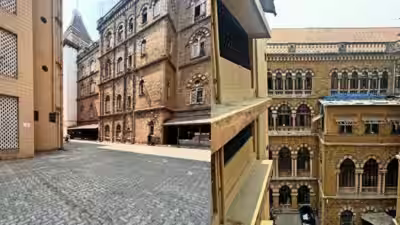











Mumbai: For years, they stood inconspicuous on the Worli seafront. Three ageing, low-slung structures occupying a nearly 5,000 sq m section of one of Mumbai’s most valuable stretches of real estate. Rabia Mansion, Marium Lodge and Sea View, overlooking the Arabian Sea, were occupied by families who were long-term tenants protected under ‘pagdi’ or rent control laws. There was even a govt transport department office in one of the buildings.However, behind their nondescript facades lay a murky web of transactions which was hidden for decades. Their landlord was a drug smuggler linked to Dawood Ibrahim, listed by US authorities under the Foreign Narcotics Kingpin Designation Act, a figure shrouded in mystery and operating from an overseas base.Today, these properties are the focus of a complex investigation by the Enforcement Directorate, leading to the arrest of the kingpin’s associates as well as businessmen like the Wadhawans, promoters of the erstwhile Dewan Housing Finance Corporation. The man himself is no more, but a cache of documents that found its way to govt agencies have provided the breakthrough needed to lift the lid on Iqbal Memon alias Mirchi’s transnational operation.From drug lord to landlordBorn into a trading family in the Musafirkhana area of south Mumbai, Iqbal Memon began his career by lending a hand in the family’s spice business, earning him the moniker ‘Mirchi’. Venturing into smuggling in the 1970s, he evolved from a small-time operator into a narcotics trafficker with interests spanning India, the Gulf and UK.Mirchi entered the hospitality sector, which became a front for his dealings. He had the Imperial Suites Hotel and a discotheque in Dubai and the Dockmasters restaurant in London. In Mumbai, he took over the Fisherman’s Wharf disco in Worli and turned it into a pick-up joint.Yet, there is little in Mumbai police records from the last few decades to connect him to most of his businesses. Mirchi relied on family members and associates like his brother, nephew and cousin to manage finances, transactions and logistics. Given the risks involved, trust was invaluable, and Mirchi reposed his faith in blood relations. From the mid-1990’s to 2013, the year he died, he shuttled between Dubai and the UK, expanding his network and evading Indian law.But in 2016, three years after Mirchi died in London, Indian authorities received a trove of his personal records from an unidentified source. The material included years of emails, bank statements, documents and correspondence with his relatives and contacts. It was a rare window into the private world of a drug boss who concealed his operations behind layers of family ties, trusted aides and offshore entities. The papers revealed everything from business disputes and money transfers to internal family tensions over inheritance.The records were rich in detail, yet by themselves did not establish a prosecutable case. Under the Prevention of Money Laundering Act, the ED can investigate only a predicate offence—a scheduled criminal case generating alleged proceeds of crime. Mirchi was dead. No active criminal case was pending against him in India. Records of prosecutions had disappeared from police archives. Investigators had information, but no legal foundation.A viable starting point emerged only when they focused on the three buildings mentioned in the records. Documents exposed their takeover from the Sir Mohammad Yusuf Trust using illegal means and their eventual sale to developers. A philanthropic body established by a shipping mogul, the trust is one of Mumbai’s largest landowners. Trustee Haroun Yusuf is accused of conniving to help Mirchi. The papers revealed a bid to conceal sale of property, creation of fake tenants after getting rid of the original ones, and transfer of funds overseas through bank accounts and hawala channels.A divided familyMirchi’s personal life was as complex as his businesses. His first wife was Hajra, a relative, with whom he had two sons, Asif and Junaid. He later married Heena, stepdaughter of celebrated filmmaker K. Asif. For years, the households functioned in parallel. Hajra moved to Dubai with her sons while Heena shifted to London. Mirchi divided time between the two cities, but when he died in 2013 that delicate balance collapsed.Investigators believe Hajra asserted claims over his London assets, triggering a dispute with Heena. Officials suspect the feud may have contributed to sensitive documents reaching authorities. When Mirchi’s sons took control of his businesses, long-time associates too were sidelined. Fearing for their safety and freedom, some may have collaborated with agencies.Brother Aslam, a customs officer who resigned to join Mirchi in Dubai, had already returned to India. Their relations had deteriorated due to financial disputes. Investigators say Mirchi even sent an associate Humayun Merchant to intimidate Aslam at his Panchgani property, leading to a police complaint.Cousin Mehmood Ismail had taken the rap for him in a case of smuggled electronics and textiles before Mirchi arranged for his release and passage to Pakistan. They reunited in Dubai, but when they fell out, Ismail visited London and recorded a testimony before an attorney. He left documents with instructions that they be disclosed if something happened to him.Nephew Nadeem, son of Mirchi’s sister, used to assist him in India and Dubai. Nadeem fell out with him after his daughter refused to marry Mirchi’s younger son, allegedly because of abusive behaviour. Fearing for his safety, Nadeem secretly recorded a conversation in London in which Mirchi was heard allegedly threatening to kill him during a discussion with his brother-in-law Baba Asif (son of K Asif and an influential stepbrother of Heena). The recording was later handed over to British authorities, who briefly detained Mirchi for questioning.Mirchi’s closest associates who had once helped build his empire and later became his targets thus turned against him after his death. Their statements have enabled the ED to reconstruct his criminal history nd confiscate assets worth thousands of crores, including a hotel plot on Juhu-Tara road. The three properties in Worli were attached under the Fugitive Economic Offenders Act last week and will be taken over by govt with court approval, unless the attachment is challenged.