








CHANDIGARH: It’s dusk in the interiors of Punjab’s Amritsar district. A farm, about 300m from the village road, is being set on fire.As flames light up the field from end to end and a thick column of smoke rises, we stop to take pictures. It is the first live farm fire I have seen in two days of travelling through the state.Our eyes are fixed on the blaze. But unseen eyes have been fixed on us. Word spreads through mobile calls and soon we are surrounded by villagers.The farmer who has just lit his field is among the first to reach us. “I waited 15 days for the balers to come and pick up the paddy stubble. No one came. How long could I wait?” he says in justification.Others voice their agreement. Baling contractors haven’t come to their block at all, leaving them with little choice but to burn the stubble, they say. One farmer says he was fined Rs 5,000 for setting his field on fire just the previous day. As more people are called in, the voices grow shriller.Delete the pictures, they demand. We assure them that the images won’t be used to identify the farmer or even the village. No one is convinced. Finally, we comply and move on.
Punjab and Haryana stubble
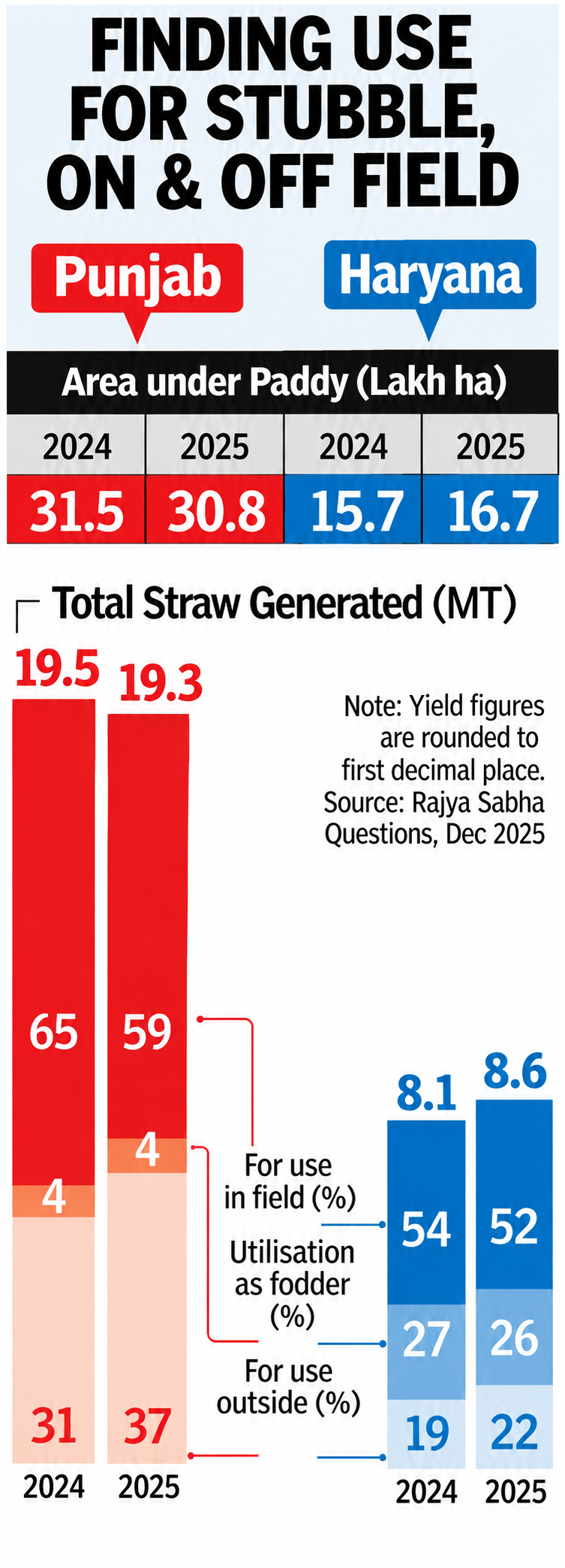
This little incident, close to the Wagah border, offers clues to the larger picture of what is happening with paddy residue in Punjab this season.There is more paddy to be managed, but also greater demand for the leftover straw. The govt’s vigil against stubble-burning remains strict, despite looming state assembly elections.Together, these factors point to a decline in farm fires this season, a trend visible on the ground as TOI travelled through 10 districts of the state last week.Yet gaps remain. As the Amritsar incident shows, it’s these gaps between the growing volume of paddy residue and an expanding straw-management ecosystem that are likely to become increasingly visible in the coming days, potentially in the form of more farm fires.First, the good news. Punjab is harvesting a bumper paddy crop despite receiving its poorest monsoon in 22 years. Farmers and officials report an increase in average yields for both basmati and non-basmati (parmal) varieties.Over three days, tracking farms across Patiala, Fatehgarh Sahib, Ludhiana, Jalandhar, Kapurthala, Amritsar, Tarn Taran, Moga, Barnala and Sangrur in Punjab, as well as Panipat, Karnal, Kaithal and Jind in Haryana revealed that, except in a few pockets, instances of stubble-burning were relatively rare.Nearly all the farmers, farm union leaders and agriculture officials said fires were down this year. As Satnam Singh, a farmer in Talwan village of Jalandhar district, put it: “Is bar jamindar aag nahi laga raha hai (farmers aren’t burning stubble this year).”
Opportunities and gaps
A major reason is the emergence of a ‘green’ sector that uses paddy straw as fuel. “Contractors have been coming to farmers to clear their fields after harvest. There’s even competition among them. I got two offers for lifting the paddy residue even before the crop was harvested,” says Manjit Singh Rai, a Hoshiarpur-based farmer and president of BKU Doaba.Most farmers, however, still have to pay contractors for the service.This is the ex situ side of crop-residue management, in which straw is collected, baled and transported for industrial use. The number of farmers opting for this appears to be rising.At the same time, aided by central and state govt subsidy schemes, a larger section of farmers continues to adopt in situ management, incorporating the stubble into the soil. This helps manage crop waste while improving soil health.However, there is a third category: farmers, mostly small landholders, who are often under greater agrarian stress. This section is the most vulnerable to burning.Whether they will eventually resort to fires in the coming days will depend on several factors: demand for straw remaining strong through the rest of the season, baling contractors finding it viable to lift residue from smaller, scattered fields, and how much time farmers have to prepare their land for the winter crop.Laxit Awla, CEO of SAEL, a green-energy company that operates 11 power plants in the region running on agri waste, believes demand for paddy straw is still insufficient to cover the entire state. “Our sense is that stubble-burning is likely to rise in the coming days,” he says.The timing of the harvest also matters. While reports indicate that more than three-fourths of Punjab’s paddy acreage has been harvested, progress varies widely.Most fields in Ludhiana, Jalandhar and Amritsar districts had been harvested. But in Tarn Taran and parts of the central Malwa region, including Moga, Barnala and Sangrur, standing crops were a common sight. This was also where several farm fires could be spotted.A delayed harvest is likely to add to the pressure as it compresses the window available before wheat sowing, often pushing farmers towards burning or hurried in situ steps.“Yes, rains in mid-Oct have delayed harvesting. However, most of the paddy still standing in the fields is basmati. Basmati stubble is not usually burnt because it is used as fodder,” says M L Jat, secretary in the Union govt’s department of agricultural research and education.
The seeder factor
Jat points out that the growing popularity of Super Seeders — machines that chop paddy stubble, incorporate it into the soil and simultaneously sow seeds for the next crop — had also had an unintended consequence. “These machines can’t manage the entire residue in one pass. The leftovers are usually set ablaze, leading to incidents of partial burning,” he says.While the Super Seeder is heavier and more energy-intensive, there is also the Happy Seeder, with one farmer — Vikas Chaudhary of Taraori in Haryana — something of a poster boy for the machine that was promoted as an early alternative to stubble-burning.“This is my 18th year running using Happy Seeder. Be it better soil health, higher yields, lower use of water and fertilisers, I have only registered gains through it,” says Chaudhary, 46. “In years when extreme weather hits the wheat crop, our yields are as much as 8 quintals/acre higher than those of other farmers. In good years, we are still 2 quintals higher,” he adds.
Counting the positives
As air quality deteriorates across Delhi-NCR, attention is likely to turn towards Punjab. There’s indeed a danger that crop fires will rise in the coming weeks, although their scale is unlikely to approach the levels seen until around three years ago. Jat, however, urges a broader assessment of the state’s progress.“Whatever happens over the next few weeks, I think, overall, Punjab and Haryana have done a great job in managing stubble and checking biomass burning. This should be acknowledged,” he says.
In 2026, a record and reason for worry
32.9 lakh hectares is Punjab’s total sown area for paddy in 2026-27 — an all-time high and an increase over 32.8 lakh hectares in 2025-26.There is also a forecast for a bumper harvest in Punjab this year, which means more stubble to deal with. Note that there is a mismatch between the Union govt data for 2025 for Punjab and figures compiled by Punjab Department of Agriculture and Farmers Welfare and authorities like Commission for Air Quality Management.