











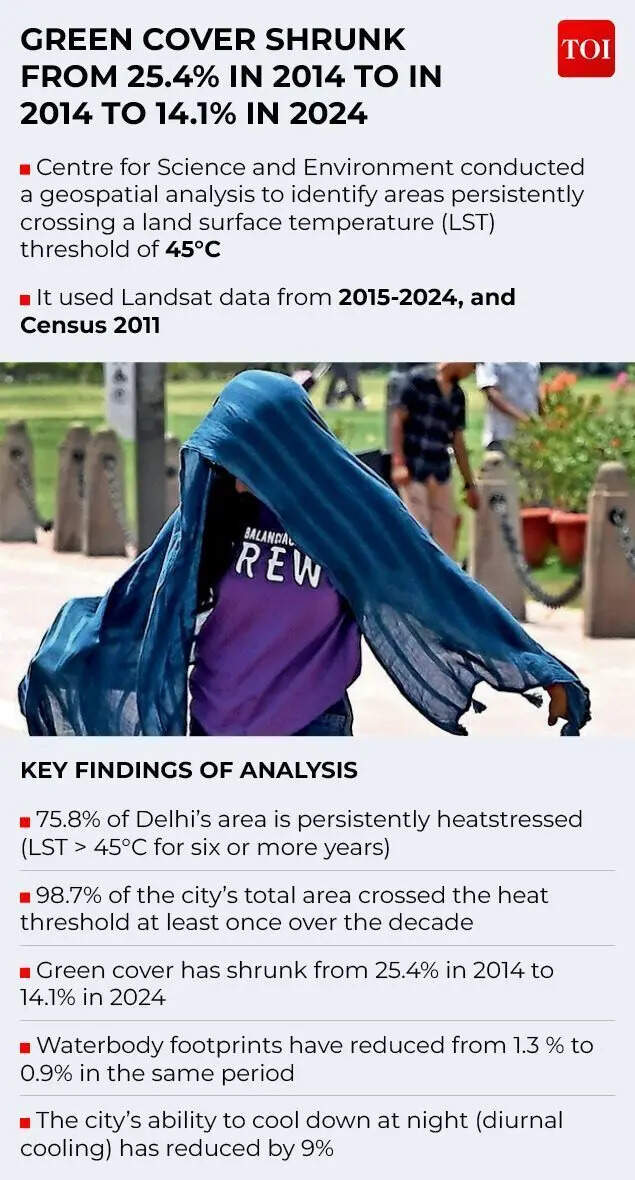
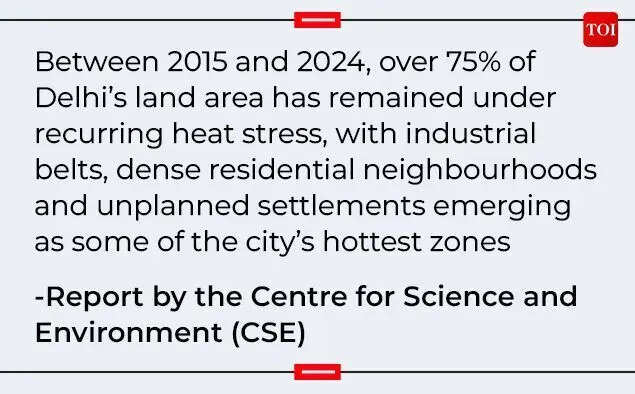
NEW DELHI: Between 2015 and 2024, over 75% of Delhi’s land area has remained under recurring heat stress, with industrial belts, dense residential neighbourhoods and unplanned settlements emerging as some of the city’s hottest zones, according to a new report by the Centre for Science and Environment (CSE).Using Landsat data from 2015 to 2024 and Census 2011 data, the centre conducted a geospatial analysis to identify areas persistently crossing a land surface temperature (LST) threshold of 45 degrees Celsius. The study found that the LST reached as high as 60.7 degrees Celsius during the summer months in locations such as Indira Gandhi International Airport or in areas with unsown agricultural lands and barren stretches.
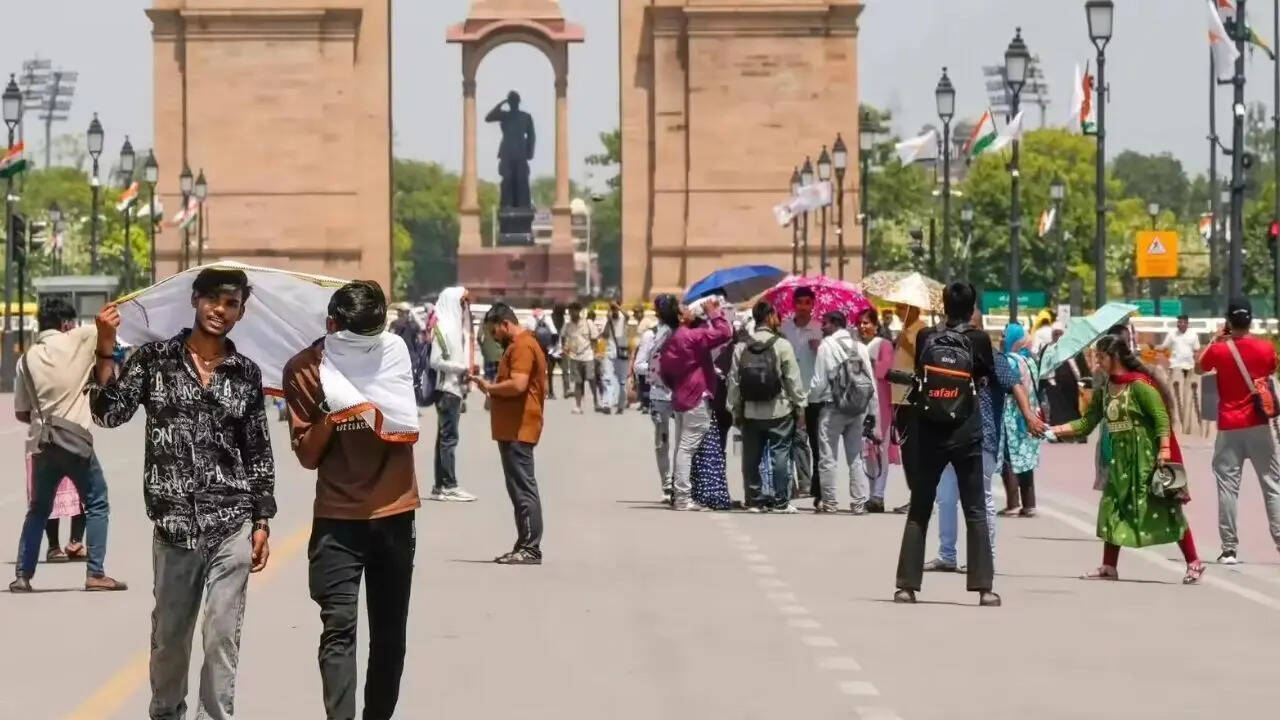
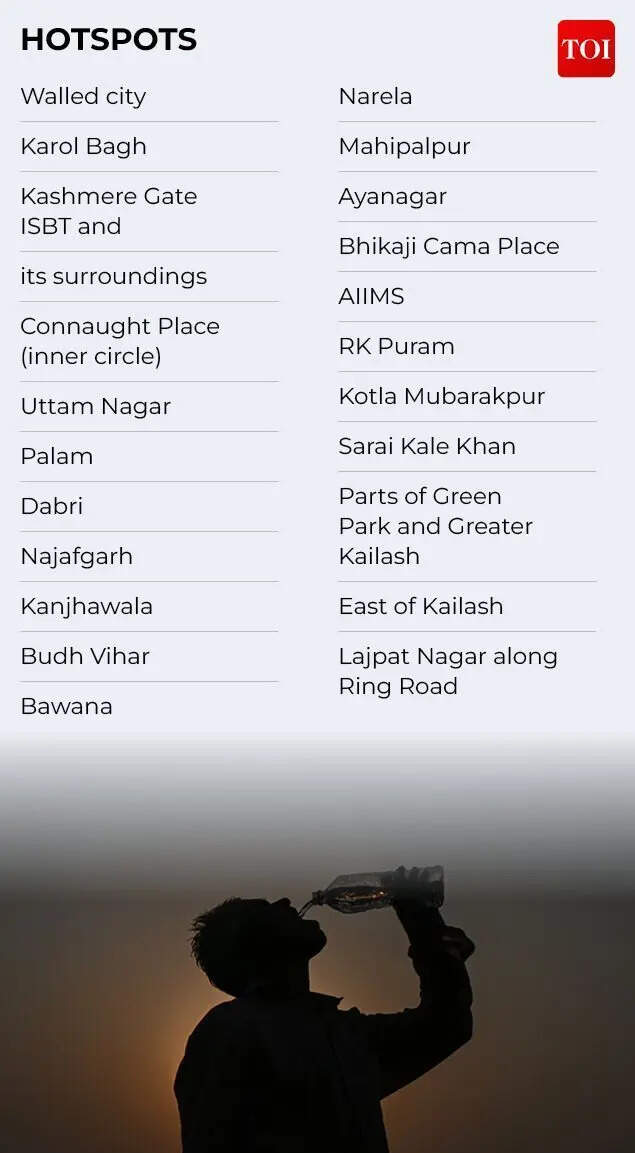
“The newly-built Bharat Mandapam and the redeveloped East Kidwai Nagar housing complex, as well as the World Trade Centre in Safdarjung and Netaji Nagar, are equally heat-stressed. As Delhi continues to redevelop, it will need to actively find ways to ensure that the new built-up fabric does not add to the entrapment of heat and instead, mitigates it,” stated the report titled ‘Making Delhi heat-resilient: a roadmap with the focus on vulnerable groups.’ The areas that have persistently crossed the heat stress threshold over the decade are the Walled City and its extensions, Karol Bagh, Kashmere Gate ISBT, and Connaught Place (Inner Circle) in central Delhi. South-west, west and north-west Delhi – with dense neighbourhoods such as Uttam Nagar, Palam, Dabri, Najafgarh, Kanjhawala, Budh Vihar, Bawana and Narela – also feature among the hotspots.
Places such as Bawana Industrial Area, Sultanpur Dabas, Puth Khurd, Anand Parbat Industrial Area, Khera Kalan, Mayapuri, Libaspur, Balli Maran, Mangolpuri Industrial Area Phase II and Mundka Industrial Area have also emerged as hotspots. In addition, several residential areas are recording an LST ranging from 44 degrees Celsius to 50 degrees Celsius. Hotspots in south Delhi include Mahipalpur, Aya Nagar, Bhikaji Cama Place, AIIMS, RK Puram, Kotla Mubarakpur, Sarai Kale Khan, parts of Green Parkand Greater Kailash, East of Kailash and Lajpat Nagar.
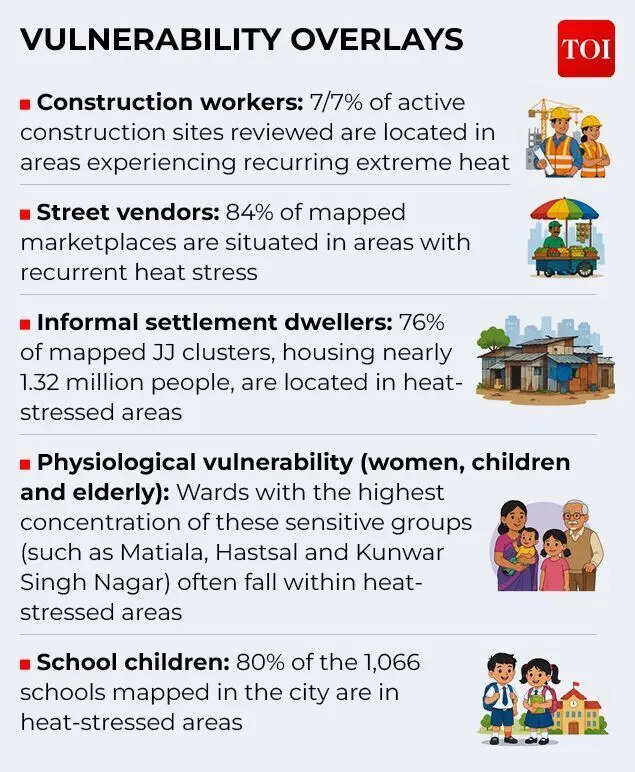
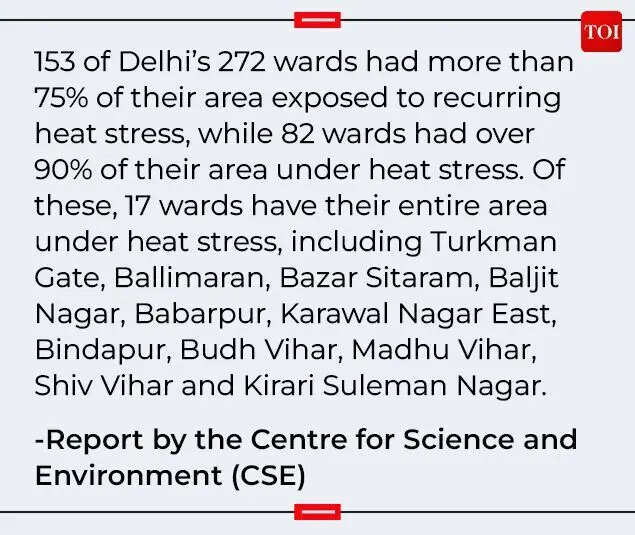
“This shows that big commercial and institutional complexes, industrial areas, high-density low-rise residential colonies and unplanned self-constructed colonies face the brunt of the heat in Delhi. However, the Yamuna river remains a heat reliever for the city, with LST around it hovering at 33 degrees Celsius, but its impact is like that of a drop in an ocean,” said the study.At the ward level, the report found 153 of Delhi’s 272 wards had more than 75% of their area exposed to recurring heat stress, while 82 wards had over 90% of their area under heat stress. Of these, 17 wards have their entire area under heat stress, including Turkman Gate, Ballimaran, Bazar Sitaram, Baljit Nagar, Babarpur, Karawal Nagar East, Bindapur, Budh Vihar, Madhu Vihar, Shiv Vihar and Kirari Suleman Nagar.
Delhi’s natural cooling systems are weakening, the study noted. Green cover reduced from 25.4% in 2014 to 14.1% in 2024 while waterbody footprints shrank from 1.3% to 0.9%. The study also revealed that the city’s ability to cool down at night -diurnal cooling -has reduced by 9%.The analysis stressed that addressing heat vulnerability requires an active management approach that combines city-level infrastructural cooling strategies, like green-blue infrastructure and cool materials, with targeted, group-specific actions to safeguard the most exposed populations. It recommended that Delhi must formally recognise heat as a disaster to utilise the State Disaster Response Fund f or relief and mitigation.“Delhi should mandate and prioritise thermally efficient roofs in industrial areas and markets as they can reduce temperatures by up to 5 degrees Celsius,” said the report.
Delhi reels under heatwave, logs warmest May night in 14 yearsDelhi continued to reel under an intense and prolonged heatwave on Thursday, with thermal stress now extending into the night as well. The city recorded the season’s first “warm night”, a condition that is likely to persist over the coming days.At Safdarjung, Delhi’s base station, the minimum temperature settled at 31.9°C, which is 5.2 degrees above normal, making it the warmest May night in 14 years, according to India Meteorological Department (IMD) data. The highest minimum temperature recorded in May so far was 34.2°C on May 27, 2012. Delhi had last experienced warm night conditions on April 9 and 10, 2025.The ongoing heatwave, which began on Monday, has shown no signs of easing. The IMD has extended its heatwave alert for the city till next Wednesday.
IMD warns of continued heatwave; orange alert till May 27A “warm night” is defined as a condition where the maximum temperature exceeds 40°C in the plains and the minimum temperature is 4.5 degrees or more above normal. A “heatwave” is declared when the maximum temperature crosses 40°C and is at least 4.5 degrees above normal. A day is also classified as a heatwave if the maximum temperature exceeds 45°C. A “severe heatwave” occurs when the maximum temperature is over 40°C and more than 6.5 degrees above normal.An orange alert for heatwave conditions has been issued for Delhi till May 27, while warm night conditions are expected again on Friday.Last May, Delhi’s highest maximum temperature was 42.3°C, and the city did not record any heatwave days.