









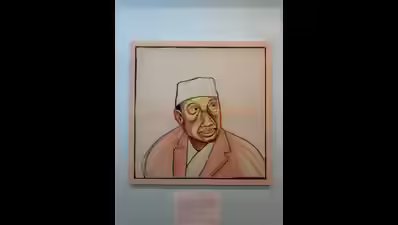
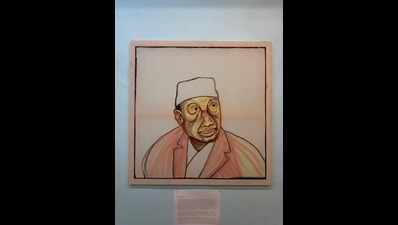
In a Colaba gallery, among portraits of slain African revolutionaries painted on khadi from Porbandar, hangs the face of a Zanzibari man for whom Mumbai offered both education and escape.Ahmad Rashad Ali carried no gun, led no army and never became president, yet for a turbulent decade in the 1950s and ’60s, British officials across East Africa considered his voice dangerous enough to monitor nightly.Few knew that this Zanzibari announcer was the voice behind ‘Sauti Ya Uhuru Ya Afrika’ — “Voice of African Freedom” — a clandestine Egyptian-backed radio broadcast that carried anti-colonial messages across East Africa in the 1950s and ’60s.Speaking in Swahili, Rashad’s voice travelled nightly across the Indian Ocean from Cairo into Zanzibar, Kenya and Tanganyika, denouncing empire and urging Africans toward liberation in the post-war era.Now, ahead of African Freedom Day on May 25, his nearly forgotten story has resurfaced in Mumbai through an exhibition at Colaba’s Strangers House titled ‘Uhuru Ya Afrika – Africa’s Freedom’.Born in Zanzibar in 1917, Rashad worked briefly as a sanitary inspector before arriving in Bombay in 1938 as a student. In his twenties, he studied at Anjuman-I-Islam, the historic institution that drew students from across the Indian Ocean world.The sea-kissed city offered him an education beyond the classroom. Here, he became a professional football player, followed the freedom movement unfolding around him, and grew politically aware through the Muslim League of Muhammad Ali Jinnah. Rashad remained in the city till 1947 and carried its political lessons onto the airwaves of Radio Cairo years later.On view until June 7, the show by Assogo Dyan Daniel, a young Gabonese-Ivorian painter, and Tony Omondi, a Kenyan researcher and translator who has lived in Mumbai for over two decades, features 14 portraits of pan-African nationalists assassinated during Africa’s anti-colonial struggles.While Rashad was not assassinated, Omondi sees the announcer as a catalyst in the pan-African movement that ended apartheid. For Omondi, Rashad’s story is inseparable from Bombay itself. “History records that between 1850 and 1910, the British Royal Navy rescued hundreds of East Africans from slave dhows and brought them to Bombay for rehabilitation,” he says.When Rashad returned to Zanzibar after the Second World War, he worked as an announcer at Sauti ya Unguja while captaining the Malindi Sports Club football team. Alongside activist Ahmed Said Kharusi, he helped produce anti-colonial material that increasingly alarmed British authorities, says Omondi.In Nov 1952, facing surveillance and possible arrest on sedition charges, Rashad fled — back to Bombay. The city became his hiding place once again. “From the information available, I believe he lived in Nagpada,” says Omondi.Before leaving for Cairo in Feb 1953, Rashad wrote a six-page letter to Egyptian president Gamal Abdel Nasser describing colonial repression in Zanzibar and asking for a job at Radio Cairo’s Swahili service. What followed became one of the least remembered media wars of the anti-colonial era.Under the patronage of Nasser, Rashad became a star broadcaster for Radio Cairo’s Swahili service and later the principal voice of the clandestine Voice of African Freedom transmissions.Broadcasting in Swahili rather than English or Arabic, Rashad carried the language of African nationalism beyond political elites and into homes, cafés and public listening gatherings across East Africa, says Omondi. Rashad’s nephew Ali Sultan Issa once recalled: “Everybody in East Africa who spoke Swahili used to tune in to that programme.”Rashad returned to Zanzibar after the 1964 revolution and is believed to have died a few decades later. No statues were raised for him. Today, Africa faces coups, foreign military presence and debt traps that echo the 1960s.“Time has come to retrieve the true heroes of African liberation from historical obscurity and highlight their contributions for the current generation,” says Omondi. “Any society that fails to honour its progenitors will certainly collapse totally.”