









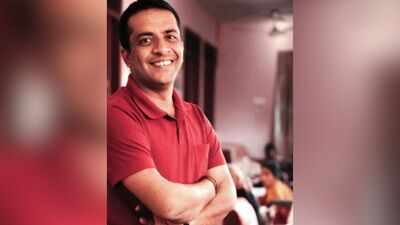
The Ramon Magsaysay award recipient has redefined the vocabulary of sharing and the undervalued significance of clothingIn the summer of 1987, Anshu Gupta was rushing home to watch Doordarshan’s popular song-based show, Chitrahaar, when a speeding tractor trolley slammed into the bike he had hitched a ride on, flinging him into the air and landing him with major leg injuries.“It was like a movie scene,” recalls Gupta, now 55. “It’s a miracle I lived.”He would walk again only after 10 months. “I played cards with fellow patients at Dehradun’s govt hospital and saw the dying. I saw both life and death at close quarters. It was education,” he says. The wounds have healed, but the left foot remains a little disfigured. The pain is a persisting companion.Gupta’s first brush with rural India’s misery and its innate flair for generosity happened in Uttarkashi, in the winter of 1991. He was a journalism student at New Delhi’s Indian Institute of Mass Communication (IIMC) and had rushed with his camera to the hills struck by a vicious earthquake. Dozens of villages had been reduced to rubble, leaving over 750 dead.The destruction all around was overwhelming, but one of the things he could never forget was the kindness of strangers: an old couple whose home was destroyed offering him tea. And the sight of a man, in a tattered jute sack, desperately pleading for blankets. “I had rushed to the spot without proper woolens. I managed to borrow blankets for the cold nights. But subconsciously, I would have imbibed how clothes can be the difference between life and death,” Gupta says.Another incident fostered that view. Back in Delhi, working on a magazine article, Gupta would witness the body of a man who had probably died of cold at the city’s Khooni Darwaza (now locked). The article profiled one Habib Bhai, who would collect unclaimed bodies for cops. Gupta remembered being told, “Jaadon mein mera kaam badh jaata hai, aur kai baar sambhalta bhi nahi (My workload increases in winter, sometimes more than I can manage).”But Gupta was still years away from his true calling. Born in Meerut, he had grown up in the remote picture-postcard settlements of Chakrata and Banbasa, and in small-town Dehradun (then in Uttar Pradesh), where his father worked as an engineer for Military Engineer Services (MES).After IIMC, he would work, among other things, as a copywriter before founding Goonj by contributing 67 personal items in 1999. The Not-forProfit organisation, which started out from his residence in Sarita Vihar, now functions out of Madanpur Khadar, an urban village in southeast Delhi.In the aftermath of the Uttarkashi earthquake, Gupta had seen relief material being randomly — and callously — tossed at survivors. “Just because somebody has lost a home doesn’t mean that they have become beggars,” he says. Experiences like these had taught him what should be given, and how. Goonj works towards that sensitised way of sharing. They talk of contribution, not donation. And empowering, not helping.At the NGO’s storage hall, roughly the size of a small single-screen theatre, mountains of blankets, yoga mats, pillows, shoes and iron trunks fill the arena. Team member Sonung Vashum says clothes arrive in three conditions: good clothes, which can be used; clothes that need repairs; and those beyond repair, which are sent to create other products through upscaling.The sorting rooms are filled with more than a dozen plywood boxes, each with labels: unstitched clothes, wedding clothes, caps, ‘chunnis’, ladies’ suits, shirts, children’s clothes, and many others. The items, carefully folded, are packed into different need-specific kits: family kit, wedding kit, dance drama kit, raahat (flood) kit, anganwadi kit and others. The school kit, for instance, contains a bag, a pencil pouch with five pencils, three notebooks, a skipping rope, and whenever possible, a water bottle and lunchbox.In another room, a group of women stitch sanitary napkins from pieces of cloth on a sewing machine. In the upscaling unit, discarded neckties morph into cushion covers, pouches and purses are crafted from cassette tapes, and old denim repurposed into smart bags. Gupta says, “We try to find ways to use everything which is usable.”The kits are transported to the hinterland, where villagers participate in local development projects — ranging from digging wells and ponds to making bamboo bridges and planting mangrove forests. “They receive the family kit with pride as an honorarium, not in the way one receives charity,” he says. And about 1.3 million ‘person work days’ were created between 2014 and 2025.Goonj employs about 1,100 people in various capacities, including interns, fellows and trainees. Between 2014 and 2025, the social enterprise, which works extensively in disaster-hit zones, has channelled 72 million kg of material, including 11 million sanitary pads prepared by them.The 2015 Ramon Magsaysay award citation has applauded “(Gupta’s) creative vision in transforming the culture of giving in India, his enterprising leadership in treating cloth as a sustainable development resource for the poor, and in reminding the world that true giving always respects and preserves human dignity.”Worryingly, Gupta has seen a dip in contributions in the post-Covid years. “You need a flood to be flooded with clothes. We don’t consider winter deaths a tragedy,” he laments. The Magsaysay recipient also points out that clothes are a basic human need, but overlooked in millennium development and govt policies.He has one dream. Gupta believes that Goonj has created an innovative, process-driven model that encourages large-scale community participation. “I want the model to travel to different parts of the world,” he says.