







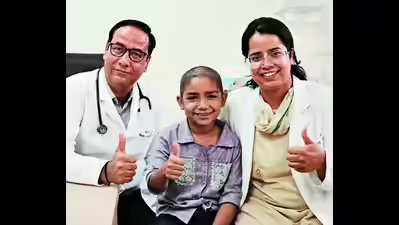
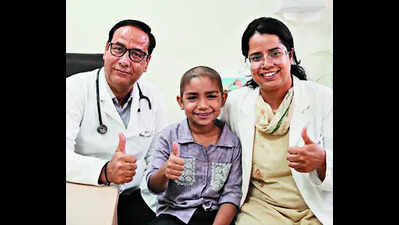
New Delhi: Diagnosed with thalassemia major when she was just two months old, Zehra’s childhood didn’t begin in classes or on playgrounds, but with hospital visits and blood transfusions.Her parents realised something was wrong when the infant appeared unusually weak and pale. Medical tests confirmed the diagnosis – a severe inherited blood disorder that prevents the body from producing healthy haemoglobin, leading to anaemia, fatigue, poor growth and organ damage over time.India carries one of the world’s highest thalassemia burdens, with 10,000 to 15,000 affected babies born every year. Yet with limited awareness and premarital screening, many discover their status as carriers only after diagnoses.A fighter, Zehra, who is now five years old, is finally cured of thalassemia and ready to step into a healthier future – one in which schools, games and birthday parties can finally take centre stage.Zehra’s journey, which began in Jaipur and was marked by years of uncertainty, had a turning point, thanks to a complex bone marrow transplant performed in Delhi.Dr Satyendra Katewa, director, paediatric hemato-oncology and bone marrow transplant at Max Super Speciality Hospital, Patparganj, said, “It’s a genetic problem. To keep such children alive, blood is transfused. But 1ml of blood has 0.9 mg iron, so 200 ml transfused blood results in 180 mg iron entering the liver, heart, testicles and ovaries, and this damages the organs. Hence, by the age of 20, majority of such patients die. Here in comes the benefit of this transplant.”However, there was a challenge: no fully matched donor was found within the family. Doctors decided to proceed with a 50% HLA (human leukocyte antigen) matched, or haploidentical (half match) transplant, a more complex procedure once considered highly risky.“In bone marrow transplant, doctors typically look for a fully matched HLA donor, often a sibling, where key genetic markers align closely between donor and patient. A haploidentical transplant involves a donor, usually a parent or sibling, who shares approximately 50% of HLA markers,” said Dr Katewa.“But such transplants can involve serious complications, including graft rejection, graft-versus-host disease and infections,” said Dr Anjali Yadav, consultant, hemato-onclology. However, within 28 days of transplant, Zehra was discharged and had her first follow-up this week. “It’s her second life, and her doctors are farishtas (angels),” said her father Aftab.Experts estimate 3% to 4% of Indians are beta-thalassemia carriers, yet awareness and premarital screening remain limited, meaning many families discover their carrier status only after a child is diagnosed. According to a Union govt report, as of March 2025, over 15 lakh individuals were screened, and 5,000 were found to be diseased and 50,462 carriers. To support the high cost of transplant, the Centre’s Thalassemia Bal Sewa Yojana contributes up to Rs 10 lakh for bone marrow transplants through empanelled hospitals.