









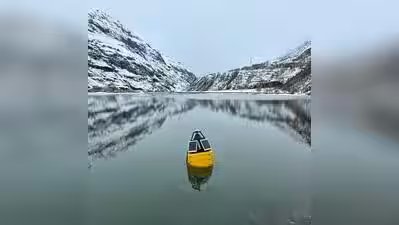
Kullu: The number of glacial lakes in Himachal Pradesh has surged over fivefold while their total surface area has more than doubled since 1990, raising severe risks of Glacial Lake Outburst Floods (GLOF) coinciding with extreme rainfall, according to a joint study by IIT Ropar and University of Technology, Sydney.Researchers found that glacial lakes in the state grew from 107 in 1990 to 669 in 2024 (a 525% increase), expanding their combined area by 102% from 5.54 sq km to 11.20 sq km. Very small lakes (0.01 sq km or less) showed the highest rise, jumping from 9 to 487.Out of 669 lakes, 88 of the 94 measuring at least 0.02 sq km are susceptible to GLOF triggers, primarily due to unstable natural dams (73 lakes), earthquake risks (58), ice cores (52), and rockfalls (44). Nine lakes were categorised as “very high hazard,” 18 as “high hazard,” and 26 as “medium hazard”.The researchers studied two high-risk glacial lakes, one each in Beas basin and Satluj basin to find out what could happen when a lake bursts during different-intensity rainfall, including an extreme scenario.In Beas basin, the researchers studied Himsu Lake, which has an area of just 0.046 sq km and is fed by a 1.19-sq-km glacier and lies about 30 km from Hurla village, and in Satluj basin an unnamed lake with an area of 0.363 sq km and fed by a 4.91-sq-km glacier.The modelling estimated that if the natural dams of the two lakes failed, the peak outburst discharge could reach 1,385 cubic metres per second from the Beas lake and 3,507 cubic metres per second from the Satluj lake, potentially causing severe flooding downstream.The study‘s flood modelling shows that in Beas basin, 94 buildings are within the inundation area under the worst-case scenario. These include the Uhl-III hydropower station and parts of Pandoh dam infrastructure. In Satluj basin, 588 buildings are vulnerable, including Koldam and its powerhouse and the Rampur hydropower project.The study warns that damage to such strategically important hydropower infrastructure could disrupt regional power supplies and cause major economic losses, while failures at one location could also worsen flooding downstream.Researchers urged state authorities to integrate GLOF hazards into dam-safety frameworks, calling for early-warning sensors to be installed at least 25 km upstream of Pandoh Dam and 100 km upstream of Bhakra Dam.BoxWhat causes a glacial lake burst?Several factors can trigger a GLOF, according to the study. These include ice avalanches, rockfalls, landslides, intense rain, cloudbursts and earthquakes. Water pressure can also weaken a natural dam, while erosion can cut into the dam and accelerate its failure. The study notes that earthquakes may trigger landslides or ice avalanches, which can then cause a lake outburst.