









Fire SOP Noida
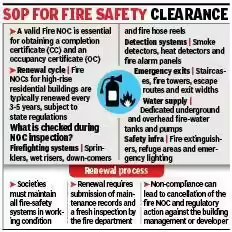
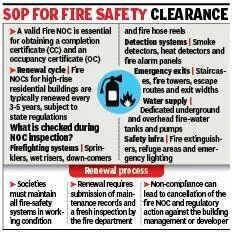
Regulatory gapsUnder Noida Authority rules, a fire NOC is a non-negotiable precondition for obtaining a completion certificate or occupancy certificate from the development authority. The NOC is issued only after a fire inspection verifies that the building complies with the National Building Code and local building by-laws. Inspectors assess active firefighting systems — automatic sprinklers, wet risers, down-comers, and fire hose reels — alongside smoke and heat detectors, fire alarm panels, dedicated underground and overhead water storage tanks, fire pumps, clear escape routes, fire staircases, refuge areas, and emergency lighting.In UP, as in most states, residential buildings are required to renew their fire NOC every three to five years, with renewal requiring updated maintenance logs and a fresh inspection filed through the state fire service portal. In practice, however, compliance effectively ends at the point of initial handover to the apartment owners’ association. Residents say follow-through on fire system upkeep after that milestone becomes sporadic and largely reactive.“Fire NOCs seem to be a joke. Even after inspections, no concrete action is taken against builders or AOAs,” said Amit Gupta, a resident of Prateek Wisteria in Sector 77.Cranes fall shortResidential highrises in Noida routinely rise 25 to 30 floors, but the city’s four hydraulic ladders can only reach up to 42 metres (14 storeys).A resident of Ivy County’s Tower B2 said that while the complex’s fire systems had functioned during the Friday morning fire and helped contain the blaze, the structural gap in the fire department’s aerial reach was again put to the test. “Given the amount a homebuyer invests in premium apartments — between Rs 2 and 3.5 crore in a complex like this — it is still appalling that mandatory safety norms are not enforced,” he said.The problem is compounded by summer conditions. Concrete structures in the NCR heat up rapidly and retain heat well into the evening. Unlike green-rated buildings, most existing residential towers have no passive cooling provisions, making fire propagation faster and evacuation more hazardous.Smoke, not flames, is the real fearResident welfare bodies said the gravest danger in a highrise fire is not the fire itself but smoke. Abhishek Kumar, president of the Noida Extension Flat Owners Welfare Association (NEFOWA), which represents several highrises in Greater Noida West, said residents on higher floors worry about whether staircases remain accessible, whether smoke enters common corridors, whether lifts become unusable, and whether rescue equipment can reach upper levels. “Families with children, elderly citizens, and pets face additional challenges during evacuation,” he said.Kumar called for stronger firefighting infrastructure, modern rescue equipment, stricter accountability, and mandatory third-party safety inspections.Demand for drone tech, SOPRajiva Singh, a resident of Stellar Kings Court in Sector 50, said the immediate priority was eliminating what he called regulatory fragmentation. “We need a single, simplified, and strictly enforced standard operating procedure that clearly defines the liability of builders, maintenance agencies, and AOAs for the upkeep of firefighting systems,” he said, adding that compliance must be verified through annual or biennial joint audits by the fire department, independent certified experts, and AOA representatives — not through paper submissions alone.Singh also called for a standardised checklist for all highrises and for quarterly mandatory drills for security staff, facility teams, and residents.Punit Sharma, president of the Noida Federation of Apartment Owners Associations (NOFAA), which counts over 120 highrises among its members, said investment in drone-based firefighting technology has become urgent. Firefighting drones can bypass ground traffic, assess conditions on upper floors beyond the reach of standard ladder trucks, deploy fire retardants at height, and reduce the need to send personnel into structurally unstable buildings. “We need more fire stations with best-in-class equipment capable of handling buildings up to 30 to 35 floors,” Sharma said.He added that the problem extended beyond highrises. Loose wiring and poorly maintained appliances within individual flats were also fire hazards requiring routine checks.