









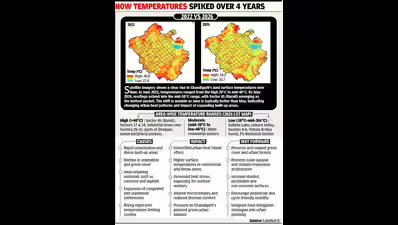
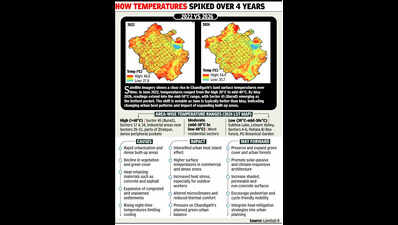
Chandigarh: As the city marks World Environment Day, a Panjab University (PU) study has flagged widening thermal contrasts across Chandigarh, with Sector 45 (Burail) emerging as the hottest urban pocket in the latest land surface temperature (LST) mapping, while areas around Sukhna Lake and the city’s green corridors continue to offer relative cooling.The satellite-based assessment by PU geoinformatics researcher Jashandeep Kakkar points to a growing “urban heat island” effect, where built-up areas absorb and retain more heat than surrounding green spaces. The findings indicate rising pressure on Chandigarh’s balance between greenery and planned urbanisation as dense construction expands. The study used Landsat satellite data—thermal infrared, red and near-infrared bands—to evaluate the impact of land-use patterns on surface heat.The May 2026 thermal map places Sector 45 in the highest temperature range recorded in the city. Researchers attribute this to dense construction, congestion, reduced vegetation and the dominance of heat-retaining surfaces such as concrete and asphalt. Other warmer zones include commercial hubs such as Sectors 17 and 34, industrial areas near Sectors 29 and 31, and densely urbanised peripheral pockets.The study also shows that unplanned or highly congested areas tend to register higher temperatures. Similar patterns were observed in villages and dense habitations adjoining the planned sectors, as well as in parts of Zirakpur and Mohali, where rapid urban expansion has transformed open spaces into built-up landscapes.In contrast, Chandigarh’s ecological assets continue to act as natural cooling buffers. Sukhna Lake remains among the coolest regions, reaffirming its role as a key heat moderator. Northern sectors close to the lake and green belts, including Sectors 4, 5 and 6, recorded lower temperatures. The Leisure Valley stretch across Sectors 3, 10, 16, 23 and 36 also showed relatively cooler readings due to extensive tree cover and open spaces. Cooler patches were observed near the Patiala Ki Rao reserved forest area and the PU Botanical Garden.Experts point out that LST differs from air temperature measured by weather stations, but remains an important indicator of how intensely surfaces such as roads, rooftops and pavements heat up, influencing local microclimates and contributing to urban heat stress.Officials from the India Meteorological Department (IMD) attribute rising heat levels to heat-retaining construction materials, emissions and increasing night-time minimum temperatures that reduce cooling between successive days. Higher night temperatures allow heat to persist, leading to stronger daytime warming.The impact is particularly significant for outdoor workers, including street vendors, sanitation workers, delivery personnel, traffic police and security guards, who remain exposed to elevated surface heat for prolonged hours. IMD officials have advised residents to remain alert to heat warnings and use early warning systems during extreme conditions.Assessing the findings, Jashandeep said residents should adopt solar-passive architecture, enhance green cover and encourage pedestrian and cycle-friendly mobility, at least for short distances. He added that Chandigarh must align its planning legacy with climate-responsive strategies to address future challenges without compromising its design ethos.