









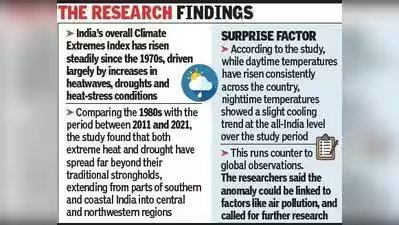
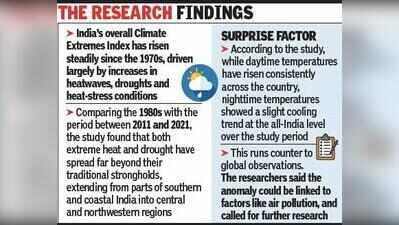
Pune: India is witnessing a clear and worsening rise in extreme weather conditions, with scorching heatwaves, deepening droughts and sudden burst of heavy rain becoming increasingly common, a new study has shown.Conducted by scientists from the National Centre for Medium Range Weather Forecasting (NCMRWF), India Meteorological Department (IMD) and Atria University (Bengaluru), the study was published in the International Journal of Climatology in July. It analysed over five decades of daily weather data from 1971 to 2022, and developed a new Climate Extremes Index tailored specifically to Indian conditions. Unlike earlier indices, it incorporated heat stress driven by humidity and prolonged dry spells, factors particularly relevant to India’s climate reality.Its findings identified northwest India, including Rajasthan, Punjab and Haryana, as the country’s most vulnerable hotspot for extreme heat. NCMRWF scientist Dr Thota Mohan said, “The region has recorded the steepest rise in daytime temperatures and the strongest increase in severe, long-lasting heatwave conditions among all regions studied.”Researchers attributed the trend to a combination of dry soils, naturally arid conditions and increasing land-surface heating.The study also highlighted Punjab and the wider Indo-Gangetic Plain, stating that intensive irrigation altered the region’s surface energy balance, potentially exacerbating heat stress in years when water availability dropped.While the north grapples with rising heat, south peninsular India is facing a different threat in drought. “We found the strongest drought trend among the country’s four climatic zones, with several recent years recording drought conditions across more than 40% of the region. Before the 1990s, such widespread drought events were rare,” Dr Mohan said.The eastern coast emerged as a major drought hotspot, particularly in Odisha, Andhra Pradesh and Tamil Nadu. Central and inland parts of the peninsula were comparatively less affected. The scientists also observed rising heat stress across the region, linking it to warming sea-surface temperatures and an extended dry period before the monsoon arrives.In northeast India, the climate story is increasingly one of extremes at both ends. The region is witnessing a rise in intense, short-duration rainfall events, signalling more frequent and powerful downpours. At the same time, prolonged dry spells are becoming more common. The researchers linked these to weakening and increasingly erratic monsoon behaviour.East-central India, traditionally regarded as the country’s monsoon heartland, stood out for a different reason. Unlike other regions, it showed no clear long-term pattern in most extreme weather indicators. The scientists said strong year-to-year monsoon variability and the influence of frequent low-pressure systems might be masking any sustained climate trend.The study’s baseline climate assessment showed that Jammu & Kashmir and the northeastern states remained relatively cooler than much of the country in terms of average daytime temperatures. The researchers, however, cautioned that these regions were not insulated from the broader warming trends affecting India.One finding surprised the scientists. While daytime temperatures have risen consistently across the country, nighttime temperatures showed a slight cooling trend at the all-India level over the study period. This runs counter to global observations, where nights generally warm faster than days. The researchers said the anomaly could be linked to factors like air pollution, irrigation-driven cooling effects or other local influences, and called for further investigation.The study, which also involved scientists Smrutishree Lenka, Kondapalli Niranjan Kumar of NCMRWF, P Rohini and OP Sreejith of IMD, and M Rajeevan, affiliated with Atria University, Bengaluru, relied on IMD’s long-term gridded weather dataset.The researchers said results might be less robust in mountainous areas and parts of the northeast, where weather station coverage remained relatively sparse.