








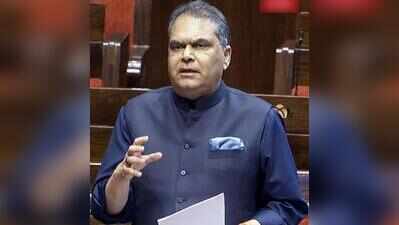
Chandigarh: Punjab and Haryana high court on Friday denied bail to Punjab cabinet minister Sanjeev Arora in a money laundering case, holding that the material placed before it did not satisfy the conditions for bail under Prevention of Money Laundering Act (PMLA).However, the bench of Justice Kuldeep Tiwari said, its observations were confined to the bail plea and would have no bearing on the trial, which the PMLA court “must decide independently, without being influenced by the observations recorded in the order”.Arora held the key portfolios of industry, power and local govt at the time of his arrest by Enforcement Directorate on May 9. He has been in custody ever since, with his bail plea being dismissed by the special court in Gurgaon on June 15. He is also a former chairman and managing director of Hampton Sky Realty Limited (HSRL), which is at the heart of the controversy.“…The investigation prima facie establishes the petitioner’s involvement, from the inception, in the generation of fictitious invoices through his accomplice, as well as in a pre-planned illegal mechanism designed to channel large transaction volumes through M/s HSRL’s accounts without any corresponding genuine transactions…”, HC held on Friday.The FIR against Arora was registered by ED at Udyog Vihar police station in Gurgaon on May 5, 2026. The prosecution alleges irregularities in mobile phone trading by HSRL. The FIR refers to sales of over Rs 157 crore in the 2023-24 fiscal, including exports worth Rs 102.5 crore to two entities in the UAE.The prosecution alleged that certain supplier entities either did not exist, were shell / dummy concerns, or lacked the financial capacity to undertake the transactions. Also, invoices were raised without the actual supply of goods, it said.Arora’s counsel, Arjun Dewan and Jasman Singh Gill, argued that there was no case against him and nothing to establish that the alleged transactions involved proceeds of crime. They maintained that the export transactions were genuine and cleared by Customs. His counsel also cited his ‘medical condition’, submitting that the trial would take considerable time, with 145 witnesses being involved.Opposing the bail plea, ED senior panel counsel Lokesh Narang alleged that Arora controlled the company and its mobile phone trading operations. ED put on record alleged discrepancies in IMEI numbers, and alleged that some phones declared as exported had been sold or activated in India. Also, a witness had been pressured to retract a statement, the agency said.HC took note of the IMEI analysis, which identified 123 identical IMEI numbers on two shipping bills, 58 handsets that were allegedly sold to domestic distributors before their purported ‘export’, and 97 iPhones declared as exported to the UAE that were subsequently activated, registered and used in India.The bench observed that Customs had not been privy to the “incriminating material” collected by ED during its investigation, and held that the issuance of a ‘Let Export Order’ (LEO) could not, by itself, exonerate Arora or establish reasonable grounds to believe that he was not guilty of the alleged offence.Rejecting the medical plea, HC noted that Arora’s condition was stable and no urgent medical intervention had been shown as necessary. It also referred to a Supreme Court order to jail authorities to ensure that all possible treatment was made available to him in the event of a medical emergency.HC concluded that the material, prima facie, indicated a fictitious export supply chain and trade-based money laundering. Arora did not meet the twin conditions for bail, the bench said, observing: “The case is an illustration of the proverb ‘something comes out of something, and nothing comes out of nothing’. Once, prima facie, there was no inward supply of goods, the subsequent export of such goods cannot reasonably be expected to have taken place.”