








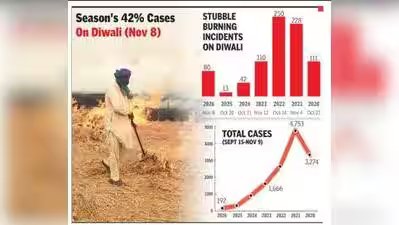
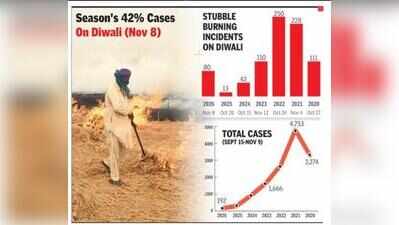
Gurgaon: Haryana has recorded 192 paddy residue-burning incidents between Sept 15 and Nov 9 this year, with a single-day peak of 80 on Nov 8, coinciding with Diwali and a deterioration in Delhi’s AQI. The Nov 8 count of 80 incidents accounts for 42% of the seasonal count. Last year, the state recorded 333 incidents of paddy stubble in the corresponding period, which was 42% higher than the current count. The sharp concentration of burning activity on Nov 8 was followed by 17 on Monday.The daily chart indicates that burning activity remained relatively low through much of Sept and Oct before increasing towards the end of Oct and into Nov. Kaithal has accounted for nearly a third of the state’s total, according to data. Together, Kaithal, Jind and Karnal account for 102 incidents, or 53.1% of Haryana’s total. The city shows zero incidents, along with Bhiwani, Charkhi Dadri, Jhajjar, Mahendragarh, Mewat and Rewari during the reporting period.Haryana had reported 959 incidents in 2024, 1,666 in 2023, 2,693 in 2022, 4,753 in 2021 and 3,274 in 2020. However, the overall decline masks considerable district-level variation. Kaithal, with 63 incidents, accounts for 32.8% of the state’s total, followed by Jind with 21, Karnal with 18 and Kurukshetra and Palwal with 17 each. Kaithal has recorded an increase from 39 incidents during the corresponding period last year to 63 this season, a rise of 61.5%. Kurukshetra’s count has increased from eight to 17, while Palwal has reported 17 incidents against 12 last year. Karnal has also recorded a marginal increase, from 15 to 18. In contrast, Jind has reported 21 incidents against 82 last year, a decline of 74.4%. Fatehabad has recorded 11 incidents, compared with 59 during the corresponding period in 2025.Ambala has reported 11 incidents, while Hansi and Hisar have recorded six each. Yamunanagar and Rohtak have reported five incidents each, followed by Sonipat with four and Sirsa with three. Faridabad and Panipat have recorded two incidents each, while Panchkula has reported one.Policy specialist in the air quality sector at Center for Study of Science, Technology and Policy (CSTEP) Swagata Dey told TOI, “Kaithal and Jind have similar areas under basmati cultivation, while Fatehabad has a relatively smaller area. Although all three districts have CRM machinery available, Fatehabad has more area under both ex-situ and in-situ management (as per current government data), which may explain the decline. Finally, the availability of farm machinery alone does not guarantee success, as other factors such as uptake rates, on-the-ground use of machinery, the success of IEC campaigns, and behavioural changes also matter. This could lead to the district-level variations. Haryana has also invested in the Mera Pani Meri Virasat Scheme to promote crop diversification. Under this scheme, the govt provides cash incentives in instalments for farmers to choose alternatives to paddy. The first instalment is paid after verification during sowing, and the second instalment is paid at the time of harvest and sale of the produce. Compared with previous years, the reduced number of farm fires is possibly because of such sustained efforts to manage and reduce crop residue in the state.”The late-season concentration of incidents also raises questions about whether farmers are able to clear residue from their fields within the narrow window between paddy harvesting and wheat sowing. Kurinji Kemanth, programme lead at Council on Energy, Environment and Water (CEEW), said, “Untimely rains had delayed Punjab’s paddy harvest by five to 10 days this season, squeezing the already limited time available before wheat sowing. This would test whether machinery available on the ground could handle peak demand.”CEEW research shows that more than 33% of Punjab farmers opt for ex-situ residue management, in which stubble is baled and used by industrial boilers, power plants or compressed biogas plants. The share is around 38% in Haryana. However, Kemanth said baling was only half the job, as bales needed to be lifted from fields on time. If they remained on farms, farmers could resort to burning because of the shortage of time.While states had made progress in deploying and adopting machinery, she said they needed to fast-track approved ex-situ biomass projects and support storage facilities in areas where surplus biomass and buyers existed. Where industrial demand was thin, machinery available with custom hiring centres and individual farmers needed to be used optimally. “Communication strategies should also prioritise technical demonstrations and peer testimonials to reduce perceived risks and build confidence in alternative practices,” she said.The district-level pattern reinforces the need for targeted intervention rather than relying only on statewide reductions. Kaithal’s rising count, alongside increases in Kurukshetra, Palwal and Karnal, points to districts where residue-management capacity and timely removal need closer scrutiny.“Stubble burning depends on harvesting dates. On that specific date, some districts may have shown an increase. IITM Pune published data on sources contributing to Delhi’s pollution (as well as forecasts). For a given period, the contribution of stubble burning to Delhi’s PM2.5 concentration is determined using active fire count data from satellites, usually received the evening before. Hence, there is a small degree of uncertainty. Meteorological factors also play a major role. Even with all these uncertainties, the maximum contribution to Delhi’s PM2.5 levels is 15%–16%. The same fire incidents for the wheat crop during summer would not affect Delhi but would cause localised poor air quality. Hence, while efforts to combat crop residue burning must continue on a war footing, Delhi and the NCR must prioritise all other sources of pollution across the airshed,” CSTEP’s Dey said.