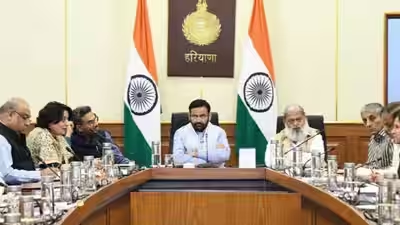








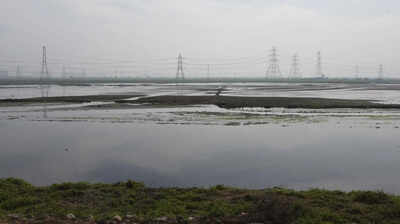
Gurgaon: In an administrative shift, the Haryana govt has moved the state Wetland Authority under the forest and wildlife department and made the principal chief conservator of forests (wildlife)-cum-chief wildlife warden (PCCF) in charge of all related works.The move follows a March 11 notification reconstituting the Wetland Authority and a subsequent March 24 departmental communication directing the Directorate of Environment & Climate Change to transfer all records, files and budgetary provisions to the PCCF (wildlife), effectively shifting control from the environment directorate to the wildlife wing. For years, the state has struggled with incomplete wetland identification, hampering efforts at conservation of wildlife around the water bodies.Earlier, wetland-related functions were handled through the directorate of environment and climate change. With this shift, wetlands are now administratively and financially aligned with the department that already manages forests and wildlife habitats. With the PCCF (wildlife) designated as member secretary, the forest department will anchor implementation, monitoring and enforcement of wetland conservation across the state.Subhash Yadav, conservator of forests (wildlife), south Haryana, said the decision to bring wetlands under the wildlife department would strengthen ecological management. “Now there will be no shortage of technical expertise to understand and manage their flora and fauna,” he said.This could mean closer integration of wetlands into habitat protection frameworks, particularly for biodiversity-rich water bodies that function as critical ecosystems.Despite the shift, the Wetland Authority continues to be chaired by the chief minister (or minister-in-charge), with the environment minister as senior vice-chairman and the chief secretary as vice-chairman. It includes administrative secretaries from key departments and technical members from pollution control, the biodiversity board and remote sensing agencies.Experts from the Wildlife Institute of India, WWF-India and the International Union for Conservation of Nature (IUCN), along with wetland specialists, have also been included.The authority retains its wide mandate — preparing a statewide wetland inventory, identifying and notifying wetlands, demarcating boundaries, regulating activities and ensuring enforcement.By moving wetlands under the wildlife wing, the govt appears to be treating them more explicitly as ecological habitats rather than just environmental assets.Environmentalists have hailed the move but say the real change will be reflected in execution. “Bringing wetlands under the wildlife wing reflects an important shift in how these ecosystems are viewed. But the real concern remains implementation. Many wetlands are still not formally notified, and boundary demarcation continues to lag, which leaves them vulnerable to encroachment,” said environmentalist Vivek Kamboj.Wetlands are transitional land areas saturated or flooded with water, either seasonally or permanently, that function as distinct ecosystems. They play a key role in groundwater recharge, flood control and biodiversity conservation, but most districts in Haryana still lack legally notified boundaries.The total wetland area in Haryana grew from 33,649 hectares in 2017-18 to 36,984.5 hectares in 2023-24, marking an increase of 3,335.5 hectares, or 10%.This growth is largely due to the creation and expansion of human-made wetlands, such as artificial ponds, tanks and waterlogged areas, as per a report titled “Indian Wetlands: High Resolution Remote Sensing Assessment and Analysis” by SAC.The state has a substantial number of man-made wetlands, totalling 25,606, with an area of 23,527.1 hectares. These wetlands make up 63.61% of the total wetland area and are used by the govt for agriculture and water management.Natural wetlands, despite spanning 13,141.1 hectares and accounting for only 35.53% of the total, are vital for biodiversity and ecological balance.The districts of Panchkula, Yamunanagar and Faridabad are expected to benefit the most if these water bodies are turned into conservation hotspots or tourist destinations, as about 2.9%, 2.2% and 1.7% of their lands are covered by wetlands, respectively. Panipat and Palwal stand in fourth and fifth positions, with wetlands covering 1.59% and 1.50% of their land. Ambala has 1.46%. Karnal’s wetlands cover 1.23% of its area, while Sonipat has 1.08%. Jind and Rohtak have 0.89% and 0.86%, respectively. Mewat’s wetlands cover 0.83%, Kaithal 0.73% and Gurgaon 0.59%. Jhajjar has 0.51%, Fatehabad 0.49%, and Sirsa 0.42%. Rewari’s wetlands cover 0.39%, Hisar and Bhiwani each have 0.32%, and Charkhi Dadri has 0.30%. Mahendragarh and Kurukshetra have the smallest shares, with 0.16% and 0.08%, respectively.