








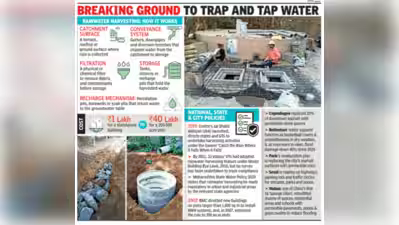
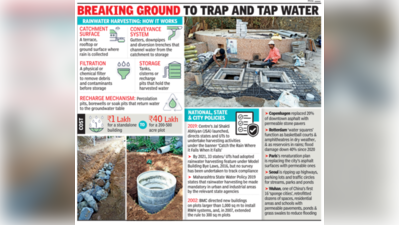
Mumbai: One hundred days’ worth of freshwater supply in volume — that’s approximately how much rainwater landed on Mumbai in the first week of July. Enough, for those inclined to measure it differently, to fill 166,000 Olympic-sized swimming pools.It’s a hot irony that the city continues to face a 10% municipal water cut, and hundreds of Mumbaikars were forced to wade where they ought to have walked. In neighbouring Palghar district, floods marooned people for three to five days without electricity or drinking water.Of the estimated 386-445 billion litres of precipitation Mumbai received within its municipal limits, an estimated 85-90% was surface runoff — between 332 and 400 billion litres washing out to sea. But only after forcing people to reckon with it on the streets first.Every monsoon, people demand better flood management, and the govt recently came up with a Rs 13,000-crore ‘sponge city’ plan that promises to soak up rainwater through bioretention parks, detention-infiltration tanks and permeable pavements.Rainwater harvesting (RWH) — the collection, storage and use of rainwater that would otherwise be lost as surface runoff — has long been viewed as a water conservation strategy. It is now also being championed as a decentralised flood mitigation measure. A network of thousands of such systems across the city could soak up water in situ and prevent runoff from accumulating in low-lying areas.“Water percolation and flood prevention are two faces of the rainwater harvesting coin,” says Rashneh Pardiwala, founder-director of the Centre for Environmental Research and Education (CERE), which has installed more than two dozen RWH systems across Maharashtra, including at fire temples in Mumbai and Pune.Inquiries have doubled in the past three years — none, though, for flood mitigation, which Pardiwala hopes will change.“It’s when water is allowed to percolate directly into the ground — because you can never have a larger tank than the ground itself — that RWH works as an anti-flooding mechanism,” she says.A 2024 paper in the journal Water Supply titled ‘Mitigating flash flooding in the city: Drain or harvest?’ recommends treating RWH systems not just as solutions to water scarcity, but as mechanisms that reduce urban flooding by preventing runoff from accumulating on streets and easing the load on drainage infrastructure — a load that has grown considerably heavier in recent years.Gripped by a grey rush to concretise its land surface, Mumbai lost 81% of open land, 40% of its green cover and 30% of its water bodies between 1991 and 2018. At the same time, monsoon patterns are becoming increasingly erratic, with rainfall concentrated into shorter, more intense bursts. In July alone, a single week brought 1,000 mm of rain — more than the month’s typical average of 768-920 mm — compounding the risk of flash floods when heavy rain coincides with high tide. With natural percolation zones closing up, decentralised RWH systems are a solution that holds water.In 2002, BMC directed new buildings on plots larger than 1,000 square metres to install RWH systems, and in 2007 extended the rule to 300 sq m plots. Yet, there is no data on how many operational systems actually exist in the city — most eventually fall into disuse, experts say. A request to BMC for this data went unanswered.Several institutions and residences, however, went it alone — and discovered downstream benefits they hadn’t anticipated.The Armed Police Headquarters of Mumbai city police in Naigaon started out trying to address water scarcity, which in 2017 impacted nearly 2,000 residential family members who stayed in the police lines. A series of trenches, nearly 3 km long, was dug along three parade grounds and connected to nine borewells. The system improved water supply — but it solved another problem too. “Every monsoon, the main parade ground would get slushy, making it difficult to conduct parades,” says Aswati Dorje, additional director general of police for the Prevention of Crime Against Women and Children, Maharashtra. With excess rainwater draining into the trenches, the grounds held up to the drills.It was Dorje who introduced Maharashtra police to rainwater harvesting, commissioning CERE to install the first system at Naigaon through CSR funding. Impressed with the results, she had another installed at the Maharashtra Police Academy in Nashik — where rainwater flowing off parade grounds was damaging adjacent roads. The system solved both problems.Floods on the Andheri-Kurla Road at Chakala were never of biblical proportion, but that didn’t stop Fr Gerard Rodricks, parish priest of Holy Family Church, from wanting to reduce them. “We’re on a hillock, where water would gush down to the road, taking mud with it. We saw it as wasted water — so 10 years ago, we installed trenches at the bottom of our property, laid with stone, gravel and charcoal, to allow water to percolate into the earth,” he says. They haven’t measured the impact on groundwater levels, but Fr Gerard considers the work done if the neighbours’ wells are fuller for it.“Traditionally, rainwater harvesting has focused on storing water for future use, while flood management has relied on quickly draining excess water away. Climate change demands that these two objectives converge,” says Prerana Langa, CEO of Aga Khan Agency for Habitat (AKAH) India. AKAH plans to install grass pavers — which enhance rainwater infiltration and reduce waterlogging — in Chandrapur and Mira Bhayandar after the monsoon.The Archdiocesan Office for Environment Mumbai is making the same argument. Its first YouTube video on the subject, launched last week, advocates deconcretisation as a way to harvest rainwater at scale: “Keep at least 30% of the area surrounding your building permeable,” says Rudolph D’Souza, recommending perforated concrete blocks for driveways, gravel-filled trenches as soak pits, and ring wells in flood-prone areas.Pardiwala believes incentives are key. “The govt should reduce property tax by 10-15% for those who practise RWH. That will create millions of little recharge pits across the city.” (In 2014, BMC announced a 5% property tax rebate for societies that implement RWH.)Each recharge pit, notes rainwater harvesting consultant Ajit Gokhale, can prevent some measure of water from reaching the road. But he warns that rainwater harvesting must work in tandem with other flood mitigation measures. “Appropriate drainage systems and the restoration of water’s natural path of movement are also essential — the upstream-downstream relationship that construction has blocked must be restored,” he says. “Rainwater harvesting cannot mitigate floods on its own, especially when water accumulates from larger areas into smaller areas and rainfall exceeds 15 mm per hour, because of soil/sand-limited absorption capacity.”Yet, Gokhale saw RWH’s flood mitigation effect at work more than 20 years ago at St Catherine’s Home in Andheri. The shelter’s gate, set at the estate’s lowest elevation, was regularly flooded during the rains. The watchman at the gate was his proof. Before the system was installed, he told Gokhale, he had spent 15-20 monsoon days standing on a chair because of water accumulating around his post. After it: two.(Inputs by Chittaranjan Tembhekar)