









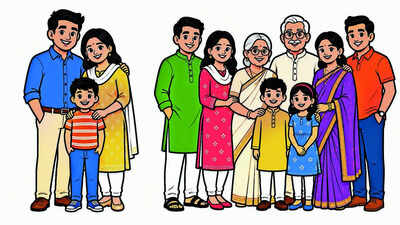
Ahmedabad: Family size in the state has officially shrunk– more than half of Gujarat’s families now identify as nuclear, according to National Family Health Survey (NFHS)-5 data. The survey puts the share of nuclear families—parents living with their children—at 52.3% in the state, with the figure higher in urban areas (56.2%) than in rural areas (49.4%).The numbers mark a rise over the past decade. Census 2011 data had shown 47% of Gujarat’s 1.2 crore households as nuclear. Census trends have also pointed to shrinking household size in the state, from 5.27 in 1961 to 4.96 in 2011.With May 15 observed as International Family Day, experts said the shift reflects changing socioeconomic realities. While more people are migrating from rural to urban areas for better livelihoods creating smaller family units, there is also a growing trend of couples wanting to stay independent of their parents. This year’s UN theme is `Families, Inequalities, and Child Wellbeing’, focusing on families as a resilient unit amid economic disparities, digital divides and other social factors.Compared to national trends, Gujarat’s shift has been relatively slower. NFHS-5 shows 58.2% of families across India identified as nuclear, higher than Gujarat’s 52.3%. In urban areas, Gujarat’s 56.2% nuclear-family share is below the national urban average of 61.3%. As a result, Gujarat has a relatively higher share of non-nuclear families—47.7%—compared to the national average of 41.8%.Gaurang Jani, a city-based sociologist, said that rise in education, improved participation of women in the workforce and marriage preferences are some of the reasons. “It is no longer taboo to ask for the parents of the girl to ask whether the boy will live separately after marriage – it often becomes a deciding factor for the unions. I also see the yearning for independence and separate identity among the youngsters that they want their own voice, and thus see the separation from mothership as a necessity. The marked shift in economic conditions after the 1990s gave the generations income to fulfil their wish to live separately,” he said.Prof Himani Baxi, faculty at the School of Liberal Studies (SLS), PDEU, said the demographic change needs to be read through multiple lenses.“First and foremost, it should not only be evaluated from a moral lens – joint families are good and nuclear families are not good is undesirable binary. In joint families, often the decisions are taken by the patriarch with relatively less room for other voices. One of the major factors for the joint families in Gujarat is its business DNA – we still have more joint families, and if we look closely, these families have members in the same businesses. Thus, the arrangement is seen as safeguarding interests,” she said.Baxi said migration for jobs and education has also contributed to families splitting into smaller units, without necessarily being driven by conflict. “What I see growing in the post-Covid years is the arrangement where the parents live in proximity of children, often in the same residential scheme. They are independent, yet close. It reflects the need for care for ailing parents while maintaining their autonomy,” added Baxi.