








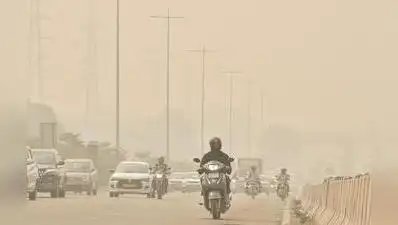
Gurgaon: The city’s 24-hour average air quality index (AQI) stayed firmly in the ‘very poor’ category for the fourth consecutive day, with a reading of 320 at 4pm on Thursday, as weak surface winds, tailpipe emissions, road dust and residual pollution from Diwali persisted.Gwalpahari recorded the highest AQI at 391, just 10 points short of the ‘severe’ threshold of 401. It was followed by Teri Gram at 334, Sector 51 at 298 and Vikas Sadan at 257. India Meteorological Department (IMD) has forecast similar weather conditions for the next two days.The city’s AQI has fluctuated over the past four days. It was 345 on Nov 9, improved to 323 on Nov 10 and 301 on Nov 11, before rising to 320 on Thursday.Central Pollution Control Board (CPCB) categorises AQI between 0 and 50 as ‘good’, 51 and 100 as ‘satisfactory’, 101 and 200 as ‘moderate’, 201 and 300 as ‘poor’, 301 and 400 as ‘very poor’, and 401 and 500 as ‘severe’.According to IMD’s forecast for Delhi-NCR, southwesterly winds blew at up to 10kmph on Thursday morning. On Friday, winds are likely to blow from the southwest in the morning at up to 10kmph, shift to the northwest in the afternoon at up to 15kmph, and weaken to 10kmph from the west by evening. Mist or shallow fog is likely in the morning.Air Quality Early Warning System, developed by Indian Institute of Tropical Meteorology, has forecast an unfavourable ventilation index for Friday and Saturday, meaning conditions will not be conducive to the dispersal of pollutants. The mixing depth is forecast at 1,400 metres on Friday and 1,500 metres on Saturday. No rainfall is forecast over Delhi-NCR during this period.Meanwhile, Haryana State Pollution Control Board (HSPCB) officials shut down a site in Sector 71 during a night inspection on Wednesday after finding construction and demolition work continuing despite restrictions mandated by Commission for Air Quality Management (CAQM). One ready-mix concrete (RMC) plant was also shut down during the enforcement drive.“After Diwali, the firecracker contribution fell sharply, yet after the brief dip, the air returned to the ‘very poor’ range. Vehicular tailpipe emissions and road dust together remain the highest contributors to PM 2.5 pollution in Delhi-NCR. Emergency curbs such as a halt in construction activities and vehicular entry restrictions help in the short run. However, sustained improvement in air quality will require stricter policy enforcement in place and year-round efforts to renew the vehicular fleet to cleaner emission norms and reduce emissions from other contributing sources,” said Prarthana Borah, fellow at CEEW.Doctors have warned that prolonged exposure to fine particulate matter (PM2.5) can weaken the lungs’ natural defence mechanisms, increasing the risk of respiratory infections and persistent allergic symptoms.“PM2.5 particles are particularly harmful because of their small size, which allows them to penetrate deep into the respiratory system and reach the alveoli, the tiny air sacs responsible for gas exchange. Prolonged exposure can compromise the lungs’ mechanisms of clearing toxins, increasing the risk of lung infections, persistent allergic cough and throat irritation despite medication and anti-allergy treatment,” said Dr Sunny Kalra, director and unit head of pulmonology at Max Hospital.Dr Kalra advised residents to limit time spent in heavily polluted locations and avoid exercising in crowded outdoor areas, as physical exertion increases the volume of air inhaled. Using air purifiers at home and workplaces, minimising indoor pollution sources such as incense sticks and mosquito coils, and choosing cleaner routes for walks can help reduce exposure. People experiencing persistent cough or breathing difficulties should consult a doctor, he added.