









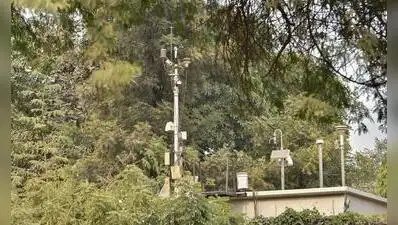
Gurgaon: Six new air quality monitoring stations are expected to be installed across the city by Dec this year, with the latest plan revising the locations proposed earlier.The issue of air pollution and compliance with norms prescribed by Commission for Air Quality Management (CAQM) was reviewed at a meeting on Tuesday. Haryana State Pollution Control Board (HSPCB) officials discussed the existing monitoring network and plans to expand it. HSPCB regional officer said the stations currently operational in the city include those at TERI Gram, Gwal Pahari, Vikas Sadan and Sector 51. Another station is operational at the HSIIDC building in Manesar.The six new stations are proposed at Maharana Pratap Swaran Jayanti Park in Sector 29, Basai water treatment plant, Tau Devi Lal Park in Sector 22, SGT University, KR Mangalam University and Starex University.The latest list marks a substantial revision of a five-station plan announced earlier. As reported by TOI, the stations were earlier proposed by HSPCB at Tau Devi Lal Park, Leisure Valley Park, Chandu water treatment plant and the sewage treatment plants at Jahaigarh and Dhanwapur. Only Tau Devi Lal Park has been retained in the latest plan.The change follows several rounds of assessment and calibration. An HSPCB official said the board conducted a 5×5 grid analysis, ensured that proposed stations were at least 5km apart and held discussions with the Central Pollution Control Board before finalising the locations. “We have included rural, semi-urban, residential and industrial locations for better assessment,” the official said.The board has also decided to shift the monitoring station at TERI Gram to Bhondsi because of its proximity to the Gwal Pahari station.“The changes in the proposed locations are significant as the selection of monitoring sites determines how effectively the network captures pollution levels across different land-use and activity zones,” the official said.The expansion assumes significance ahead of winter, when particulate pollution generally intensifies across NCR. Gurgaon’s existing network covers roughly 732 sq km, leaving large parts of the city, particularly newer sectors and fringe areas, without direct monitoring. A wider network can provide more location-specific data and help authorities identify pollution hotspots and assess the impact of local emission sources.The city’s monitoring network has also faced disruptions. In Oct last year, three of the four stations operating at the time — Gwal Pahari, TERI Gram and Sector 51 — went offline because of technical problems and delayed calibration, leaving Vikas Sadan as the only functional station.TOI had also reported concerns over dense tree cover around some stations and gaps in pollutant data. Experts had said limited monitoring points and gaps in data could affect the accuracy of Gurgaon’s overall pollution profile, particularly when the AQI is based on data from a small number of locations.During Tuesday’s meeting, Haryana’s principal adviser, urban development, DS Dhesi, directed HSPCB to ensure timely installation and effective functioning of the new stations. He also called for coordinated measures to control air pollution and ensure compliance with CAQM norms.