









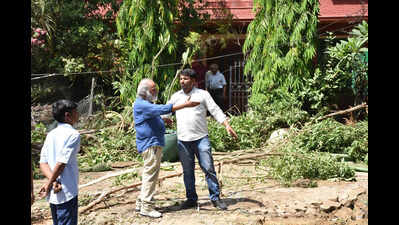
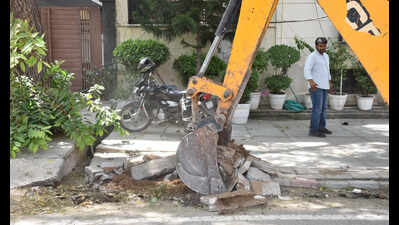
Gurgaon: In several colonies, roads meant for free movement had been squeezed by years of illegal lawns, ramps, grills, guard rooms and boundary extensions to the point that even two cars could not pass together on some stretches.The shrinking of public space and right of way — repeated across internal roads, green belts and footpaths — actually triggered a demolition drive that entered its fourth day on Tuesday, with the town and country planning department clearing fresh encroachments across eight licensed colonies.The crackdown, one of the city’s biggest in recent years, follows a Punjab and Haryana high court stay on Haryana’s stilt-plus-four-floor policy and a state order asking agencies to clear right-of-way violations by April 22. Officials said the exercise is aimed at reclaiming public land that had steadily disappeared under unchecked extensions.“All encroachments within the right of way — from 9 metres to 24 metres — have to be cleared in a time-bound manner before April 22. In several places, residents had pushed grills and structures so far into the road that the carriageway was severely compromised. After the removals, roads have visibly opened up,” district town planner (enforcement) Amit Madholia said.Three days of demolitions have also begun to produce a second effect — voluntary compliance. In parts of Sushant Lok-1 and DLF Phase 2, residents started dismantling illegal extensions after appeals by RWAs and warnings from officials. In Sushant Lok-1’s D Block, residents of nearly 250 houses began clearing projections, while in Maple Block, most households removed illegal structures by evening. In DLF Phase 2, around 350 houses shifted planters, removed grills and cleared extended portions before teams arrived.Officials said the “cooperation” reduced the need for coercive action, but warned that the campaign would continue across all licensed colonies. “This is not a one-off exercise. Residents were given time to remove violations voluntarily. But in places where there was no compliance, enforcement became necessary. There will be no relaxation for repeat violations,” Madholia said.Residents expressed mixed reactions to the drive. While most agreed that encroachments had steadily narrowed internal roads and made movement difficult, some questioned the manner in which the demolition was carried out.“This has been completely arbitrary. We were given no proper time to respond, and suddenly bulldozers showed up and demolished structures that have existed for years. If these were illegal, why did authorities allow them to come up in the first place? It feels selective and unfair. Residents are the ones bearing the loss,” said Rohit Malhotra, a resident of DLF Phase 2.Others said the action was necessary but poorly executed. “Encroachments had become a real problem. Roads were getting too narrow and movement was difficult. But the way this has been carried out is harsh. Some notice and a phased approach would have helped. While the intent seems right, the execution has caused inconvenience and confusion for many families,” said Neha Arora, a resident of South City 1.On Tuesday, the drive in DLF Phase 2 covered M Block, Akashneem Marg, parts of L and L Extension, Cassia Marg and Q Block, where around 800-900 houses were inspected. Officials said more than 250 illegal lawns and railings were removed, over 80 guard rooms demolished and hundreds of smaller violations cleared.In South City 1 and Greenwood City, teams cleared encroachments along a 13km stretch, removing around 70 shopfront ramps and extensions, 29 guard rooms, eight tin sheds and 12 temporary structures, besides demolishing ramps, grills and staircases outside 40 houses.At Palam Vihar, boundary walls and fencing were removed from nearly 150 houses in Block A, along with 16 guard rooms. In Sushant Lok-2, teams cleared a 12km road network, removing ramps, guard rooms, DG sets placed on public land, boundary walls and encroachments on green areas. Action was also carried out in Uppal Southend, Sector 49, Sushant Lok-1, Malibu Town, Vipul World, Alameda, Ansal Versalia and Essencia.The wider drive began earlier in DLF Phase 1 and has since spread across South City 1, Palam Vihar, Sushant Lok-2, Uppal Southend, Malibu Town, Ardee City and Suncity. Officials said misuse of stilt floors meant for parking, and the steady conversion of public-facing spaces into private extensions, had added to infrastructure stress and safety risks across these colonies.Some residents, however, backed the campaign, saying it had restored road space. “This action was long overdue. Many people had extended their boundaries onto public land, making roads unusable. After the drive, the streets look wider and more organised. If rules are to be followed, they should apply to everyone. This is a step in the right direction,” said Amit Bansal of DLF Phase 1.