








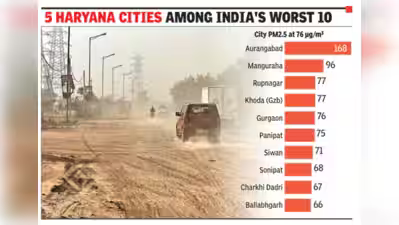
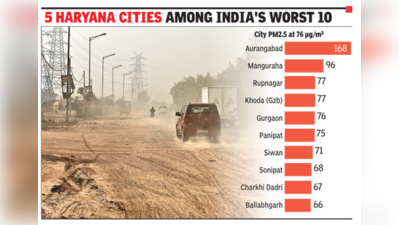
Gurgaon: Five Haryana cities featured among India’s 10 cities with the highest average PM2.5 levels in Aug. The Aug data covered 257 cities across the country. The city ranks fifth in the country at 76 µg/m³.The city is followed by Panipat, with an average PM2.5 concentration of 75 µg/m³. Sonipat was eighth at 68 µg/m³, Charkhi Dadri ninth at 67 µg/m³ and Ballabgarh tenth at 66 µg/m³. “We have miles to go. We are working towards achieving clean air,” an HSPCB official told TOI on Monday.PM2.5 — tiny airborne particles that can penetrate into the lungs — cause and worsen respiratory issues and cardiovascular diseases. High exposure, even for a month, can pose serious risks to vulnerable populations, including children and the elderly.The city’s average PM2.5 concentration was nearly twice that recorded in Delhi, which ranked 44th among the 257 cities with an Aug average of 39 µg/m³, according to an analysis of air pollution data by Centre for Research on Energy and Clean Air (CREA).Bihar’s Aurangabad topped the list with an average PM2.5 concentration of 168 µg/m³, followed by Manguraha in the state at 96 µg/m³. Rupnagar in Punjab and Khora in Uttar Pradesh shared the third position at 77 µg/m³, while Siwan in Bihar ranked seventh at 71 µg/m³.Beyond the top 10, Manesar ranked 11th nationally with an average PM2.5 concentration of 66 µg/m³, followed by Bahadurgarh at 12th with 65 µg/m³. Narnaul and Fatehabad ranked 13th and 14th respectively, both at 65 µg/m³. Karnal ranked 16th at 61 µg/m³, Panchgaon 17th at 60 µg/m³, Bhiwani 18th at 59 µg/m³ and Dharuhera 20th at 56 µg/m³.Manoj Kumar, an analyst at CREA, said, “Monitoring coverage in Haryana was broadly consistent, with most cities having data for all 31 days. Hisar had 28 monitored days, Panchgaon 29 and Sonipat 30. The analysis shows that Haryana’s air pollution problem during Aug was not confined to the city or a few industrial centres, with cities across different parts of the state featuring prominently in the national rankings.”Kumar also said the city recording 76 µg/m³ while Delhi recorded 39 µg/m³ in Aug should not be interpreted simply as one city having twice the pollution of the other across the entire airshed. “Delhi has received more rainfall in Aug compared to the city, which makes a huge difference. Delhi and the city are part of the same broader NCR airshed, but being in the same airshed does not mean that every city will record the same PM2.5 concentration. City-level pollution is influenced by the combination of regional pollution transport and local emission sources, including traffic, construction and road dust, industries and other combustion sources. Meteorological conditions such as wind direction, rainfall and atmospheric dispersion can also cause significant differences between locations, even when they are geographically close,” he said.“Similarly, the relative position of Noida and Ghaziabad can vary from Delhi and Gurgaon because pollution is not distributed uniformly across NCR. Ghaziabad, Noida, Delhi and Gurgaon have different local emission profiles and different mixes of residential, commercial, industrial and transport activity. At the same time, pollutants can move across city boundaries, so these should not be treated as completely independent pollution systems. The Aug numbers are therefore useful in identifying local hotspots, but they need to be read alongside meteorology, source contributions and station-level data to understand why neighbouring cities can show substantially different averages,” he added.Noida was at the 46 spot with PM 2.5 concentration of 39µg/m³ while Ghaziabad stood at 47, having PM 2.5 concentration of 37 µg/m³.Asked about CREA’s findings, officials of Haryana State Pollution Control Board (HSPCB) said on Monday that the city’s air quality has improved compared to last year. The HSPCB official told TOI, “There has been a reduction in pollutants, but it is true that the ground reality has not changed completely. Coal-based industries have been shifted out of NCR cities and many have converted to PNG. Road infrastructure has also improved in the last four years and awareness about pollution has also increased.”The analysis also showed that pollution remained widespread across Haryana. Of the 25 Haryana cities covered, 18 recorded average PM2.5 concentrations of at least 40 µg/m³, while 11 recorded levels of 60 µg/m³ or higher.WHO’s daily PM2.5 guideline of 15 µg/m³ was not met on any day in the city during the month. Panipat, Sonipat, Charkhi Dadri and Ballabgarh also recorded zero days below the WHO daily guideline. Among Haryana cities, Sirsa recorded the highest number of days below the WHO guideline at 11, followed by Panchkula with six, Hisar with three, Kaithal with two, and Palwal and Panchgaon with one each.The remaining 19 cities recorded no such day. The data also showed that most of the state’s polluted cities fall outside the National Clean Air Programme (NCAP) city list. Of the 25 Haryana cities covered in the analysis, only Faridabad is identified as an NCAP city, while 24 are outside the programme’s city list.