







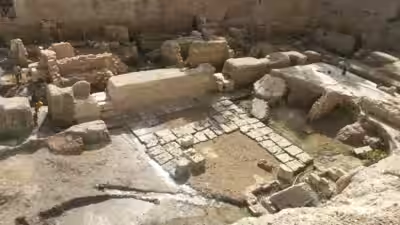
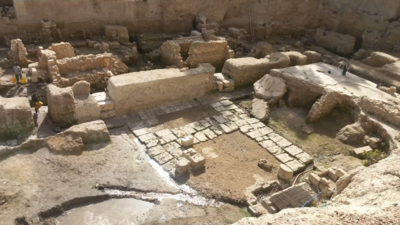
Massive limestone foundations uncovered in Alexandria’s ancient Royal Quarter may belong to a Ptolemaic royal tomb, a find that offers new evidence for the layout of one of the city’s key historic districts. A Greek mission led by Kalliopi Limnios-Papacosta discovered the Shallalat Gardens, where the foundations form a large, roughly square plan suggesting a tall building. Egyptian officials describe the possible royal burial link as an early hypothesis rather than a confirmed identification. Even so, the discovery gives archaeologists a fresh reference point for understanding how this part of the ancient city was built and used.
How a Greek team’s 20 years of digging in Alexandria’s Shallalat Gardens revealed huge foundations
According to Egypt’s Ministry of Tourism and Antiquities, the mission belongs to the Hellenic Institute for Research on Alexandrian Civilisation. It is funded by the Moheb Kassabgui Foundation and Reliance Egypt, and has worked in the Shallalat Gardens area for about 20 years. Its latest work exposed the foundations of a large limestone building surrounded by walls. A tunnel runs from beneath the building towards the north.
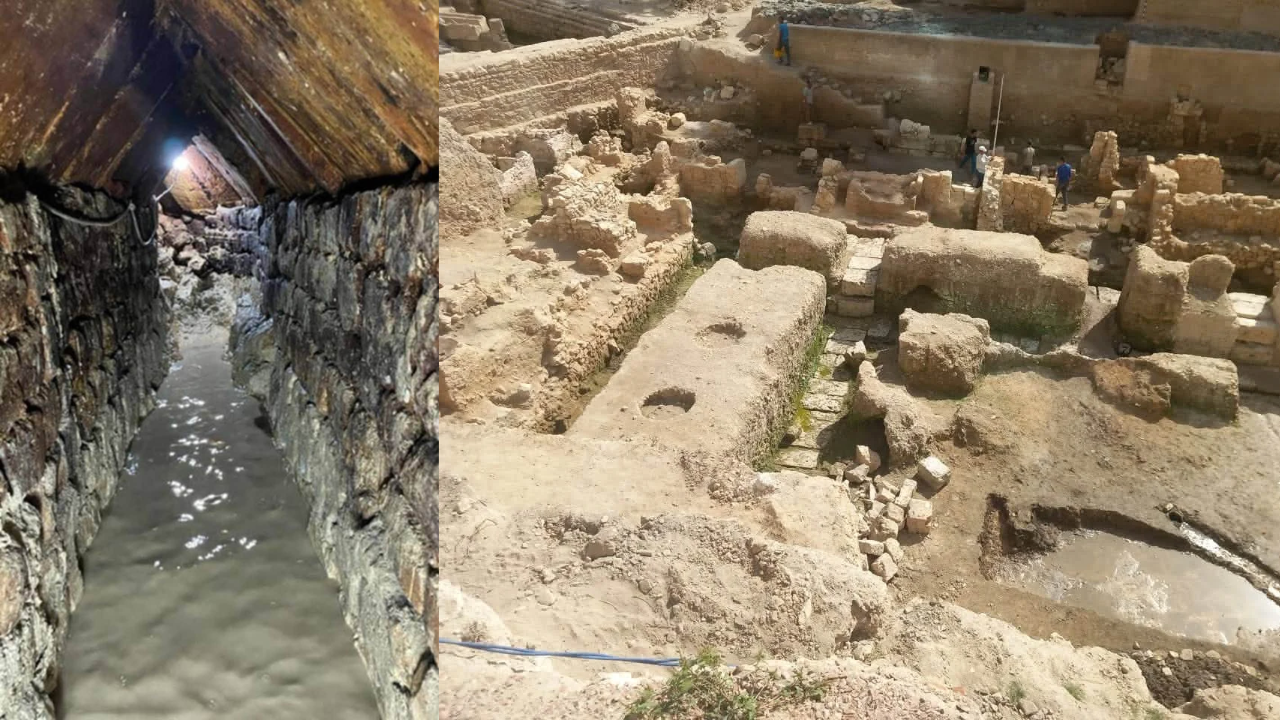
Tunnel beneath the building (Image: Egyptian Ministry of Tourism and Antiquities)
What Egypt’s expert committee found at the Royal Quarter foundations in Alexandria
As Archaeology News reported, Sherif Fathy, Egypt’s Minister of Tourism and Antiquities, formed a specialist committee after receiving the mission’s report. It was headed by Ayman Ashmawy of the Supreme Council of Antiquities, who leads its Central Administration for Lower Egypt, Sinai and the North Coast. Senior specialists and professors of Greek and Roman history and antiquities from Alexandria and Tanta universities joined him to inspect the site, study the architectural remains and verify their importance.The committee submitted its report to Hisham El-Leithy, Secretary-General of the Supreme Council of Antiquities, who passed it to the minister. The report confirmed that the site lies within the royal quarter, one of the city’s most prominent historical areas, and noted the foundations’ square dimensions. It also stressed the find’s value for studying the topography of ancient Alexandria and tracing how far such massive foundations extended.
Why the building may be linked to the Ptolemaic royal tomb that Strabo mentioned in Alexandria
The committee said the building’s nature and architectural features raise the possibility of a funerary function. If so, it may be the “royal necropolis” that historical sources say King Ptolemy IV Philopator founded, who reigned from 221 to 204 BCE. The ancient Greek geographer and historian Strabo referred to it in his description of Alexandria. Ashmawy said the idea remains under research, with excavation continuing to confirm the building’s identity and function.
What happens next at the Shallalat Gardens site and why the discovery matters for Alexandria
El-Leithy said the committee’s initial conclusions confirm the site’s importance, particularly given its position inside the royal quarter. He said the find opens new horizons for studying royal structures in Alexandria during the Ptolemaic era. He added that continued archaeological and architectural research is needed to understand the building’s nature, its function and its relationship to the structures around it.Ashmawy described the discovery as an important scientific addition to the study of what stood in the royal quarter and the architectural and cultural roles those buildings played. Further excavation and studies, he said, may yield more data about the building and the structures associated with it.Fathy said successive discoveries in Alexandria confirm the city’s unique archaeological and cultural heritage, and the historical evidence it still holds that can reveal new aspects of its history and urban development. He said the ministry will keep supporting Egyptian and foreign archaeological missions and strengthening scientific cooperation with research institutions and specialised universities to advance research and preserve Egypt’s cultural heritage.