








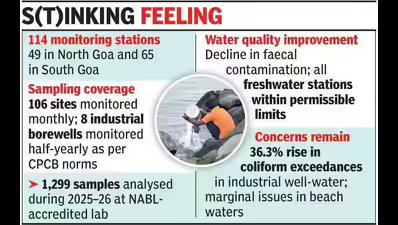
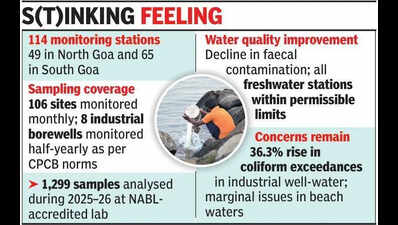
Panaji: A report by the Goa State Pollution Control Board (GSPCB) has stated that Goa’s air quality remained in the “good” to “satisfactory” category for most of the period between April 2025 and March 2026. However, water quality continues to be a concern, with marginal exceedances of faecal coliform levels detected in some water sources, including beach waters.According to the report, air quality ranged from “satisfactory” to “moderate” in industrial estates such as Cuncolim, Tuem, Bicholim, Vasco, Baina and Kundaim. Field observations around monitoring locations indicated the prevalence of anthropogenic activities, including vehicular movement, construction work, and road excavation.The GSPCB monitors water quality at 114 locations across Goa under the Central Pollution Control Board (CPCB)-sponsored National Water Quality Monitoring Programme (NWMP).The monitored water bodies include rivers, wells, canals, lakes, reservoirs, creeks, nallahs and common sewage treatment plants (STPs), where both inlet and outlet samples are tested. The river network includes estuarine and freshwater rivers, particularly water intake points supplying treatment plants for public water distribution. Groundwater sources, including borewells located within selected major industrial estates, are also monitored. In addition, 20 coastal shoreline locations along Goa’s beaches are included under the NWMP network.Of the 114 monitoring stations, 49 are located in North Goa and 65 in South Goa. A total of 106 locations is monitored monthly, while eight borewells situated within selected industrial estates are monitored on a half-yearly basis, in accordance with CPCB protocols.During 2025-26, the board collected and analysed 1,299 samples from these locations at its NABL-accredited laboratory.The report noted a significant decline in faecal coliform and faecal streptococci levels in nullah and outdoor bathing water samples compared to 2024-25. It also highlighted a marked improvement in freshwater quality, with all monitored stations remaining within permissible limits during 2025-26.However, a significant increase of 36.3% in total coliform exceedances was observed in well-water samples collected from industrial areas compared to the previous year. The report also recorded marginal exceedances of faecal coliform levels in beach waters monitored by the GSPCB.Faecal coliform exceedances in drinking water samples from Salmona spring remained unchanged from 2024-25. Meanwhile, exceedances in samples from the 12.5 MLD outlet of the Panaji Tonca STP, monitored under the NWMP, declined by 25% during 2025-26.