








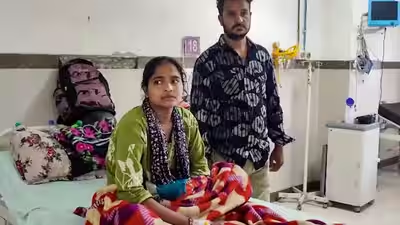
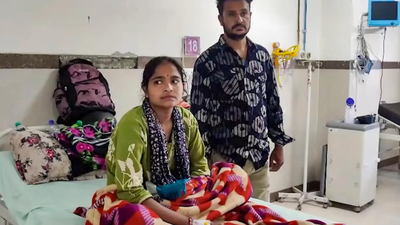
KOTA: What was meant to be a two-day hospital stay ending with a newborn in their arms has turned into a prolonged ordeal for five women at Kota’s New Medical College Hospital (NMCH). More than two months after undergoing caesarean deliveries, they continue to battle kidney infections that have left them dependent on dialysis.The five women have undergone a total of 32 rounds of dialysis over the past 68 days. Meanwhile, five other women at NMCH and JK Lone Hospital died from complications following caesarean deliveries.On Wednesday, the families of the five women wrote to President Droupadi Murmu seeking permission for euthanasia if they are not provided kidney transplants, news agency PTI reported.As per the PTI report, the memorandum, sent through speed post, came after the women refused further dialysis and demanded either kidney transplants or death. Their families said a representation submitted to district authorities on Monday seeking kidney transplants had failed to elicit any response.“She is terrified of the word dialysis now,” Mohan Lal said about his wife, Dhanni Suman, who has remained admitted at NMCH since the first week of May.“Within an hour of starting the process, she begins vomiting, shivering violently and has a high fever. She cannot eat anything on those days,” he told PTI at the hospital.Mohan Lal had earlier said the families could no longer watch the women suffer.“We cannot watch them suffer like this anymore. If they do not give us a written assurance for kidney transplants within 48 hours, we will stop bringing them for dialysis and let them die. We are living like walking corpses,” he said.On Wednesday, however, NMCH principal Dr Nilesh Jain said the five women with kidney complications were clinically stable and fit to be discharged.He said they had been fit to return home for the past 20 days and could continue dialysis on an outpatient basis.At least 80 patients undergo maintenance dialysis at the hospital every day and routinely visit the facility for the procedure, he said.Responding to the women’s refusal to undergo dialysis, Dr Jain said toxic waste would accumulate in the body if treatment was discontinued, leading to severe health complications.He added that if the patients refused dialysis, the hospital would formally inform the district administration for necessary intervention.On the demand for kidney transplants, Dr Jain said a patient suffering from acute renal failure must be observed for three to six months before being categorised as having end-stage renal disease (ESRD). Discussing transplants at this stage, he said, would be premature.Among the affected women is 29-year-old Ragini Meena, who is now completely dependent on dialysis.“My sister came here to deliver a baby, expecting to stay for just two days,” her brother, Vikas, said.“Today, she cannot survive even 24 hours without dialysis. Every 48 hours, she has to undergo the procedure,” he added.According to Vikas, Ragini’s husband, Lokesh, who worked at a finance company, lost his job while caring for her, and the family is now borrowing money to survive.Mohan Lal, a cab driver, said he too had to sell his taxi—his only source of income—to continue his wife’s treatment.“Keeping up with the expenses became impossible. I had to sell my taxi. Now, even those funds are almost completely exhausted,” he said.Their baby, born on May 8, is being looked after by a relative, while their two other children, aged five and 10, are staying with their grandmother.Pinki Aerwal’s husband, Naresh, alleged that the government had ignored the plight of families whose loved ones continue to battle the complications. Their child, delivered on May 8 at JK Lone Hospital, died shortly after birth.“They gave Rs 5 lakh to the families of those who died, as if a human life is only worth that much,” Naresh said, referring to the financial assistance announced by Lok Sabha Speaker and Kota MP Om Birla for the families of women who died due to the infection.“What about those who are trapped in between, the ones who are dying slowly every single day?” he asked.The Rajasthan government has ordered an inquiry into the post-delivery complications reported at Kota hospitals.Authorities have also banned the supply of certain drugs after they were found to be substandard, although officials said they were not directly linked to the postpartum complications.Apart from Kota, cases of maternal deaths have also been reported from Bikaner, Bhilwara and Banswara.(With agency inputs)