








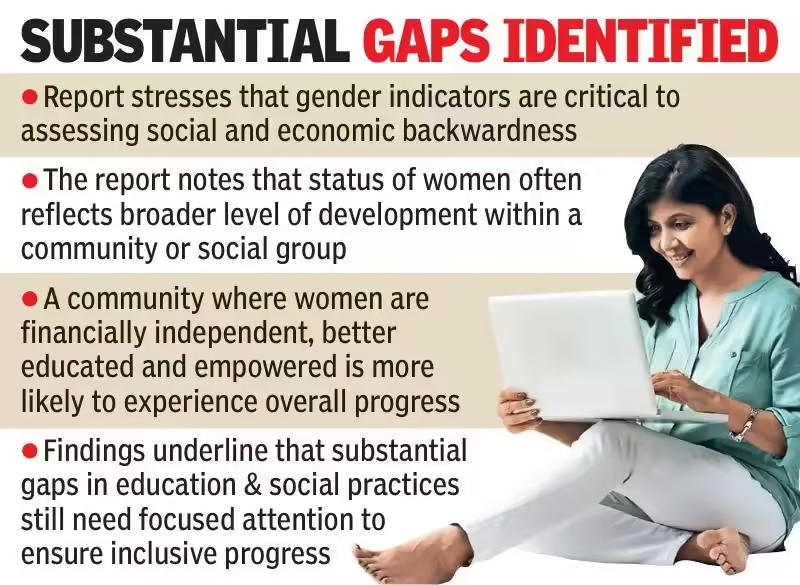
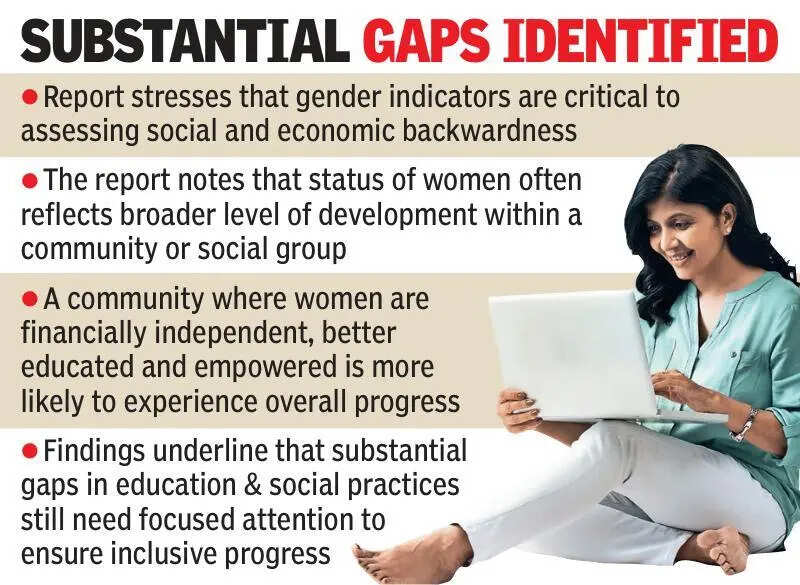
Hyderabad: Even as the women’s reservation bill moves closer to reality, Telangana’s caste survey signals that deeper gender inequalities continue to persist across communities, raising questions about how far political representation alone can drive change.The Socio-Economic, Educational, Employment and Caste (SEEEPC) Survey-2024 reveals that nearly 67% of women across castes are educated only up to below class X, pointing to significant gaps in educational attainment. The survey also highlights that child marriage, though declining, remains a concern, with around 4-5% of girls—nearly 2.16 lakh under the age of 18—already married.The state’s female-to-male ratio stands at around 97.9%, indicating a relatively balanced demographic profile. However, variations across communities are striking. Some groups, including ST Gonds, ST Koyas, SC Malas and SC Madigas, report ratios higher than 1, while others such as OC (other castes) Iyengars/Iyers, OC Jains, OC Rajus and OC Muslims fall significantly below the state average. Child marriage figures reveal sharper disparities. While the overall rate hovers around 5%, certain communities show disproportionately high numbers. Among major castes, OC Iyengars/Iyers record the highest share of girls married below 18 at 21.2%, nearly five times the state average, followed by OC Jains at 11%, more than double the average. Status of womenThe report stresses that gender indicators are critical to assessing social and economic backwardness. It notes that the status of women often reflects the broader level of development within a community, influencing access to education, healthcare, autonomy and economic opportunities. “Further, a community where women are financially independent, better educated and socially empowered is more likely to experience overall progress and well-being. Thus, gender is not just one of many dimensions—it is central to understanding the depth and nature of backwardness within any social group,” the report said. The findings underline that while legislative measures like women’s reservation aim to enhance political participation, substantial gaps in education, social practices and empowerment still need focused attention to ensure meaningful and inclusive progress.