








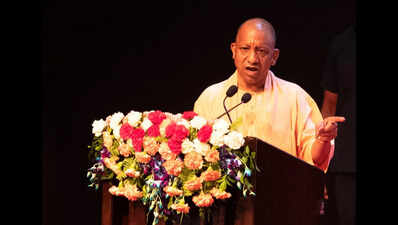
Lucknow: Chief minister Yogi Adityanath on Monday said the nearly 600-km-long Ganga Expressway has been built without taking loans from banks, presenting it as a sign of the state’s improved financial strength and administrative discipline.Addressing a programme at Lok Bhawan during the distribution of appointment letters to newly selected auditors, the chief minister said more than Rs 36,000 crore has been spent on the expressway, while the total expenditure, including industrial clusters and logistics hubs being developed along the corridor, has crossed Rs 42,000 crore.He said nine industrial and logistics hubs are being developed along the expressway and around 7,000 acres of additional land have been acquired for them. According to him, Uttar Pradesh now has the capacity to complete large infrastructure projects using its own resources.“Before 2017, this was not the situation. The state was considered BIMARU, and no bank or financial institution was willing to give loans. But now Uttar Pradesh is a revenue-surplus state,” Adityanath said.The chief minister said that when his govt took office in 2017, the state treasury was under severe strain and financial institutions were reluctant to lend to Uttar Pradesh. He said the govt then chose to focus on increasing internal resources, enforcing financial discipline and improving financial management instead of depending on borrowings.He said this approach helped the state avoid burdening people with excessive debt and contributed to strengthening the financial structure of the govt. He credited the finance department along with local and panchayat audit teams for functioning as an internal support system in this process.Adityanath said that although banks and financial institutions later showed interest in funding the Ganga Expressway, the govt decided to proceed without external borrowing. He also claimed that the state has reduced loans taken by previous govts.The chief minister said Uttar Pradesh is now among the top three state economies in the country, whereas earlier it was counted among the bottom three. He added that the state became revenue surplus and succeeded in tripling its economy, per capita income and budget.Adityanath also cited the Jayaprakash Narayan International Centre (JPNIC) project in Lucknow as an example of financial indiscipline before 2017. He said the project began with an estimated cost of Rs 200 crore, which later rose to Rs 860 crore, but remains incomplete. He described it as misuse of public money and said it was an insult to the legacy of Jayaprakash Narayan.The chief minister further said the state’s excise revenue has risen sharply over the years. According to him, Uttar Pradesh earned around Rs 12,000 crore from excise before 2017, while the figure has now increased to about Rs 62,000 crore to Rs 63,000 crore after leakages were plugged. He said these leakages were caused by misuse within the system rather than technical issues.At the event, Adityanath distributed appointment letters to 371 newly selected auditors for the Cooperative Societies and Panchayat Audit Department and 129 auditors for the Local Fund Audit Department. He said internal audit plays a crucial role in ensuring financial discipline in village panchayats, municipal bodies and district-level institutions, which he described as the foundation of development.He also said the recruitment process was transparent and merit-based, with no appointments made through recommendations. Referring to earlier years, he alleged that paper leaks, nepotism and irregularities in recruitment were common before 2017, often resulting in disputes and court cases that harmed young aspirants.“The current system ensures equal opportunity for all, regardless of religion, caste or region, and selection is based purely on merit. The govt follows a policy of zero tolerance towards crime and corruption,” he said.Highlighting women’s participation, the chief minister said 78 women were among the 371 selected candidates in cooperative and panchayat audit, while 25 women were among the 129 selected in local fund audit.He added that more than 9 lakh govt jobs have been provided so far and that appointment letters are being distributed regularly. He also said govt policies have generated employment for around 3 crore people in the MSME sector, while schemes such as Drone Didi, Lakhpati Didi, BC Sakhi, dairy initiatives, PM Startup, PM Stand-Up and the Chief Minister’s Youth Entrepreneur Scheme are helping youth and women access livelihood opportunities.