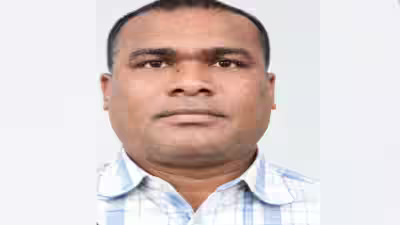






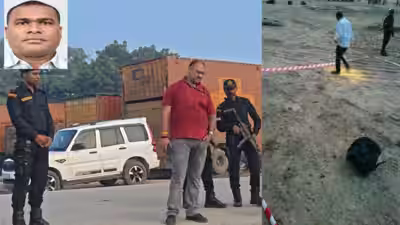
LUCKNOW: From being briefly associated with the CPI (Maoist) to breaking away and building a rival extremist outfit, and later becoming an elected village head, Brijesh Ganjhu’s journey reflects the complex trajectory of extremist politics in Jharkhand’s forested belt.His death in an encounter with the Uttar Pradesh Anti-Terrorist Squad (UP ATS) in Varanasi on Sunday brings an end to the career of one of the most wanted TSPC commanders.Ganjhu, also known as Gopal Singh Bhokta, Dular Chand, Ranjan, Phulchand and Sardar, was a resident of Lutu Sohawan village under Lawalong police station in Chatra district. A ₹30-lakh reward had been announced for his arrest, including ₹25 lakh by Jharkhand Police and ₹5 lakh by the National Investigation Agency (NIA).Ganjhu’s association with the extremist movement began with the CPI (Maoist). He later broke away from the organisation and, in 2004, helped establish the Tritiya Prastuti Committee (TSPC) as a rival outfit, senior officials associated with the probe said.The emergence of the TSPC opened a new chapter in Jharkhand’s extremist landscape. Rather than remaining part of the CPI (Maoist) network, the organisation sought to establish its own influence in areas where the Maoists had traditionally operated, the officials added.Under Ganjhu’s leadership, the TSPC expanded its activities across parts of Chatra, Ranchi, Hazaribagh, Ramgarh, Palamu and Latehar, as well as areas of Bihar, according to security agencies.Ganjhu entered local governance even as security agencies continued to link him with extremist activities.In 2010, he was elected unopposed as the mukhiya of Lawalong panchayat. His election to the local body did not, however, sever his alleged links with the TSPC. Police continued to identify him as an important figure in the organisation, while he remained on the radar of security agencies.The TSPC’s emergence led to a prolonged contest for influence with the CPI (Maoist). For nearly two decades, the two organisations were involved in a bitter rivalry across parts of Jharkhand.The confrontation resulted in clashes and violent incidents involving cadres of both groups. The conflict also affected civilians living in areas such as Lawalong, Kunda and Pratappur, where competing extremist groups sought to consolidate their influence.The rivalry was not merely ideological. Security agencies have linked the activities of extremist groups in the region to struggles over territorial influence and extortion networks.The UP ATS said more than 45 cases had been registered against him in connection with offences including murder, attempted murder, kidnapping, criminal conspiracy, extortion, arson, attacks on public servants and illegal possession of arms and explosives, besides provisions of the UAPA.Ganjhu remained elusive for nearly 20 years, according to the UP ATS. Intelligence agencies had been tracking his movements, with the ATS saying that he frequently changed his appearance and locations to evade security agencies.