






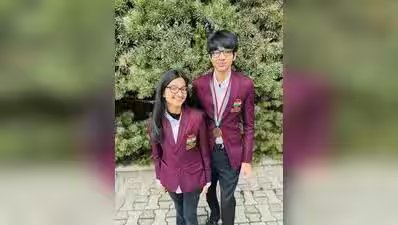
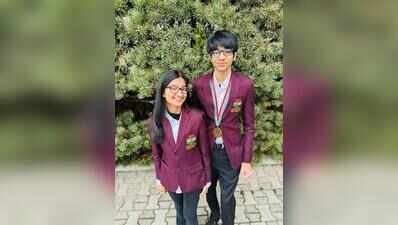
Mumbai: One trains with his body. The other trains with her mind. Vir Gahrotra (17) spends hours working on strength, flexibility and choreography for aerial-silk routines performed nearly 30ft above the ground. His sister Viha (14) can spend eight hours at a bridge table, calculating bids, reading opponents and trying to work out what they are holding before they reveal it.The Worli siblings are competing at the top of two very different disciplines. Vir won India’s first-ever gold at the Pole and Aerial Sports World Championship in Hungary last December. Last Wednesday, Viha won a world title of her own, taking gold in the Under-16 Final B at the 9th World Youth Transnational Championship in Hefei, China.Their routes into the sports were equally unexpected. Vir took up aerial silk as physiotherapy for underdeveloped thigh muscles. He was eight when his mother signed him up after seeing a festival performance. Viha picked up bridge after a family friend, himself a three-time Under-16 world champion, conducted a boot camp at her school.Neither was deliberately steered towards an unusual sport. “It just happened organically. It was not a conscious decision,” says their mother, Kaushal Sanghvi.Aerial silk combines strength, flexibility, balance and artistic performance, with athletes climbing, wrapping and dropping through lengths of fabric while suspended high above the ground. Vir trains against the physical demands of the sport as well as an infrastructure gap: while European competitors can train in facilities with ceilings of around 30ft, finding even 18ft of clearance in India can be difficult.He is used to explaining the sport to classmates, who question whether it counts as one or is similar to mallakhamb. Aerial silk is still awaiting recognition from the Indian Olympic Association.The siblings’ training looks nothing alike. Vir works on strength, flexibility and control in the air; Viha trains strategy, memory and anticipation, much of it through online coaching. She trains for up to nine hours a day during her monthly camps.Bridge is an established mind sport, but finding coaching in India remains a challenge. “If she would’ve said ‘I want to play badminton,’ it would have been easier to find a badminton coach,” says Sanghvi. “Bridge, that was our main struggle.”Viha’s classmates also question whether cards can count as a sport. She describes bridge as “a mix between cards and maths” involving bidding systems, covert signalling and reading an opponent’s hand.“If you consider chess a sport, then you have to consider bridge a sport,” she says. “Bridge actually has three different parts.” Also, she says, “It’s recognised by the International Olympic Committee.”At Hefei, Viha competed in the open format, which allows multinational teams. She teamed up with India’s Ananya Mehta and players from Norway and England whom she first met at a bridge event in Poland two years ago. The title comes a year after she reached the final four representing India at the Junior Bridge World Championship, narrowly missing a medal.