








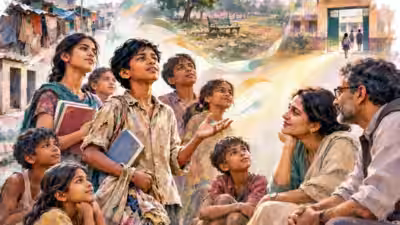
NEW DELHI: “Can you get my elder brother a job so I won’t have to work?” At 12, Akash (name changed) picks rags to support his mother and younger brother and help pay off the family’s debts. He started working after his father died in 2025. When he got a chance to speak to members of the Delhi Commission for Protection of Child Rights (DCPCR), he had a specific request. If his brother could find work, perhaps he could stop.Akash was among 48 children from 22 institutions who took part in an interactive session with representatives of DCPCR. The children, aged 11 to 16, mostly live in shanties across the city. They spoke about what keeps children from studying, what makes them stay away from a neighbourhood park and what happens when adults fail to act on dangers the children can see.For Anisha (name changed), 16, reaching Class X meant going further in school than anyone else in her family. She spoke about girls who want to continue studying but face restrictions. “Many girls want to study, but they don’t allow it,” she said.Children also told the panel how substance abuse figured in their lives. A 14-year-old from Mangolpuri said he and his friends avoided their local park because people gambled and used drugs there. “They also threaten to stab each other when they fight,” he said.Another 14-year-old, from Nizamuddin, alleged that a woman sold drugs to children in his neighbourhood, where he said some users were as young as eight. “Police are there but they do not do anything,” he said.Another teenager brought up a danger near his home in northwest Delhi. He recalled how someone went to bathe in Bhalswa canal and never came back. He asked the panel to consider a basic safeguard for people who go there. “There is no signage where the place is dangerous,” he said.When the discussion turned to crimes against women and girls, a 14-year-old had a question for the panel. “When will this end?” he asked in Hindi. DCPCR member Swati Gupta replied, “When boys stop doing it.”DCPCR chairperson Dr Om Prakash Vyas spoke of the responsibility adults and institutions have towards children. “When we don’t do our duties, we may end up violating the rights of others,” he said.Commission member Kundan Kanskar said people in children’s immediate and wider circles needed to stay vigilant, as gaps in support could leave children exposed to harm.Sanjay Gupta, director of CHETNA (Childhood Enhancement through Training and Action), the NGO that organised the session, said children should have a say in decisions that affect their lives. The panellists discussed various steps that could help these children.At the session, some children also pointed to problems at home, in school and in their neighbourhoods.A 12-year-old asked where she could seek help for her parents’ frequent quarrels, while a Class VIII student said his teachers were rude to him after he lost his books and clothes when his home in Tughlakabad was demolished.A 14-year-old asked for sanitary pads to be made available at school, and a 13-year-old questioned why students still needed private tuition after classes.A child living under a flyover in Nizamuddin said there were no community toilets or bathing facilities and that they had to pay Rs 10 to use a toilet and Rs 30 to bathe.