









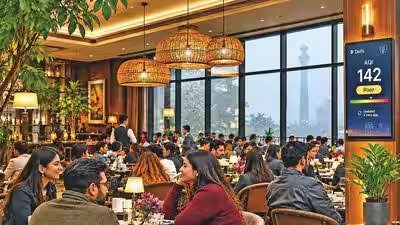
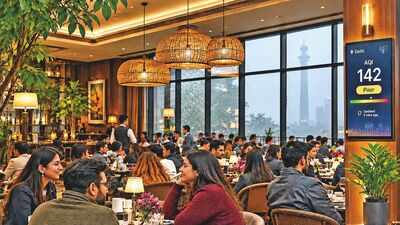
Uff, finally I can breathe,” a guest remarked as he took the table next to mine at a restaurant in Malcha Marg, relieved to be indoors after battling burning eyes and a sore throat outside. And he is not alone. As the annual pollution season starts and Delhiites prefer to stay indoors, businesses are adapting to keep footfall steady.‘Guests are asking for indoor tables’For cafes with terraces and open-air seating, the challenge is harder. Jai Ojha, Marketing Head at Cafe Lota, Triveni Terrace Cafe, and Roots, says the pollution has affected both the experience and footfall. “Over the last two to three days, guests at Roots have asked for indoor tables. If only outdoor seats are available, they are okay to go elsewhere. My friend who runs Cafe Auro, which also has a large terrace, is also facing a dip in business over the last month,” he adds. The team is considering ways to cover terrace areas, and including makeshift panels with circulating water to keep dust out. “But again, we can only do so much,” says Ojha.Environmentalist and activist Jai Dhar says Delhi’s pollution has changed where he feels safe dining. “Our public places urgently need health and safety compliance when it comes to air. If somebody like me, who is asthmatic, were to visit a restaurant, café or hotel, I would not go to one that doesn’t have a good air-purifying system. There are enough people like me who have been carrying their own personal monitors around. Most people in Delhi now have respiratory problems, so I’m not taking anything for granted.”Sumeet Dabas Founder, Cafe Casa Dunes, shares, “As part of our efforts to address rising AQI levels, we are sprinkling water twice a day to settle dust and minimise airborne particles in the surrounding areas. We also have ample indoor seating to ensure guests can enjoy a comfortable dining experience while being protected from outdoor conditions.”‘There is 0% impact of plants on dust particles’Planting trees cannot replace mechanical solutions to Delhi’s air pollution. “The primary pollutants in Delhi are dust particles, PM2.5 and PM10. There is 0% impact of plants on dust particles. The only thing plants do is reduce stress and hypertension. But they do not impact air quality,” says Jai Dhar, adding, “They can act as a wall, which is why we were trying to build this wall in the Aravallis to control the dust particles from the desert. But they do not have any impact on air pollution. In fact, what air pollution does to plants is that it blocks the stomata on the leaf. It blocks the pores, the stomata on the leaf, so the plants are not producing oxygen anymore.”
I think that model of dining (outdoor dining) is gone. Outdoor dining does have benefits, but not in Delhi anymore. The only time you can do that in Delhi is during the monsoons
Jai Dhar, environmental activist
“Plants are all myths. We should work towards preventing the pollution instead of creating a false sense of satisfaction that everything is well. If things are done with good intent, there is a lot that can be done to curb Delhi’s air pollution,” adds clean air activist Bhavreen.‘We are trying to elevate comfort amid pollution peaks’“It’s very saddening that during this season – when everyone in Delhi knows it’s the season for meeting people, with Diwali and a festive energy all around the city – this whole thing (pollution) comes around, and the business dips,” says Ojha.But hotels and restaurants are complying to this demand. Anmol Ahluwalia, Area Director, Operations and General Manager, Taj Mahal, New Delhi explains that at his hotel, ensuring superior indoor air quality is a key priority. Ahluwalia explains that, “Guest awareness around air quality has certainly increased, particularly during periods of heightened pollution in Delhi. While concerns around air quality remain an important consideration for travellers, the hotel’s investment in advanced air purification technology, medical-grade HEPA filtration, continuous monitoring, and enhanced ventilation systems helps ensure that indoor spaces remain comfortable and aligned with prescribed air quality standards, allowing guests to enjoy the property’s hospitality offerings with confidence.”
The hotel tracks key air quality indicators including particulate matter (PM2.5 and PM10), carbon dioxide levels and other relevant air quality parameters. Our monitoring systems track carbon dioxide levels, which are maintained below 1,000 parts per million
Anmol Ahluwalia, Area Director, Operations and General Manager of a luxury hotel
Year-round filtrationAs outdoor plans become less appealing, indoor destinations are seeing a growing preference. Akashdeep Singh, Centre Director, Nexus Select Citywalk, says dedicated air purification systems have run across the mall 365 days a year for the last three to four years. Indoor AQI monitors let visitors compare the air inside with the air outside. Singh says they are seeing “a growing preference for indoor destinations where visitors can enjoy a more controlled and comfortable environment.”Ahluwalia shares that Taj Mahal, New Delhi has installed Swedish air systems with multi-stage filtration, while every guest room has been fitted with Electronic Air Filters.