











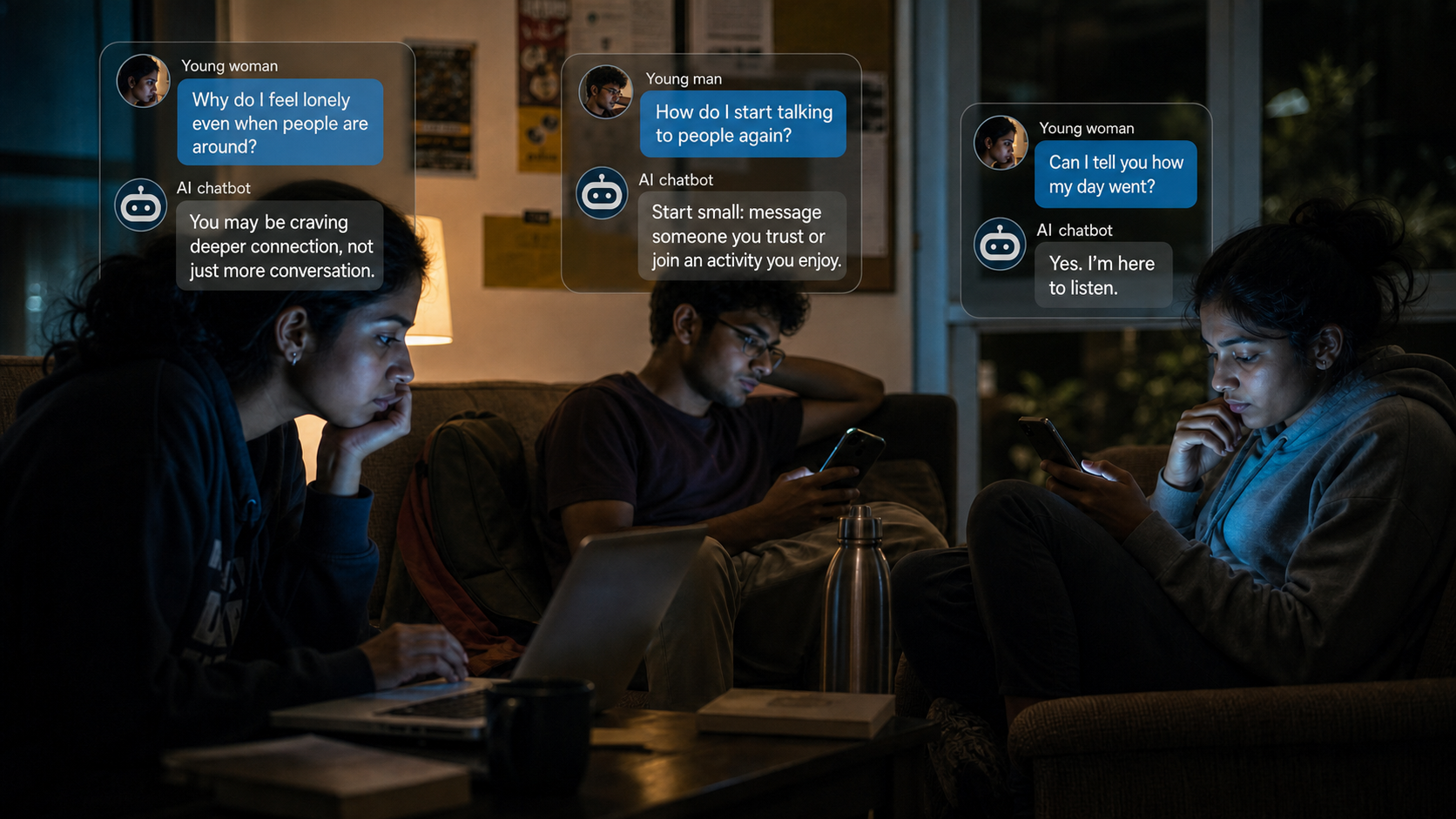
Guwahati: For 21-year-old Bishrut (name changed), AI offers the only space where he gets judgement-free responses. From seeking advice on building emotional connections to sharing small, everyday moments, he has increasingly turned to AI for the companionship and understanding he struggles to find elsewhere.
AI chat
“It is judgement-free space. It is sort of a therapy which is free,” he says.Once confined to science fiction, turning to machines for emotional support is becoming increasingly tangible. Experts say this reflects a wider shift, with young people relying on AI for assignments, interpreting health symptoms and increasingly seeking emotional reassurance and companionship.“A large proportion of the people we encounter with such problems are between 16 and 28 years. The nature of their problems is different from those seen among people above 30. Unlike previous generations, who spent more time playing outdoors, socialising and maintaining face-to-face friendships, many youngsters today spend long hours on their phones and increasingly turn to technology for interaction and support,” says Nimi Borgohain, a psychologist.Borgohain stressed that while AI can be useful, excessive reliance on it may discourage youngsters from developing independent thinking, exploring issues on their own and maintaining meaningful human relationships.“The growing reliance on AI for emotional companionship should also be viewed against the changing nature of urban social life. With long working hours, academic pressure, increased screen time and fewer informal meeting spaces, opportunities for spontaneous interaction have reduced,” she says.Shravani Bhattacharyya, another psychologist, says unlike human relationships, AI chatbots are available round the clock and respond almost instantly, without visible judgement. This immediacy, she adds, makes AI an easy outlet for people who may be hesitant to share their thoughts with others, as human responses may not always be readily available.“The absence of ‘third spaces’ — places beyond home, work or college where people can socialise — is leaving many with fewer opportunities for genuine connections. There is also a biological reason why social interaction is important. Interacting with others activates mirror neurons, which help children understand emotions and social cues. If children spend too much time on digital devices instead of playing and interacting with others, these opportunities may be reduced. Providing spaces for children to play and connect can support their social and cognitive development,” she adds.