





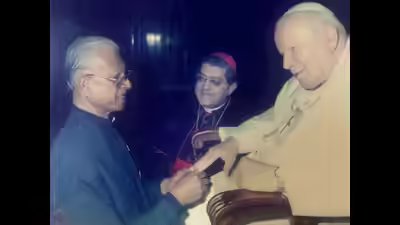
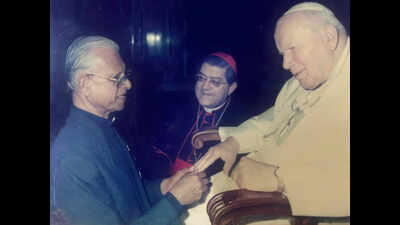
Panaji: Cabo Verde’s dream World Cup debut is being cheered across the world. But tremors felt some thousands of miles east had a different echo altogether — a strange umbilical cord joining two former Portuguese colonies through its love for football, music, and saudade, that unique emotion of melancholic longing.Cabo Verde’s performance resonated extra bright in distant Goa. Former Portuguese colonies both — Cabo Verde gained independence in 1975 — their link extends even deeper through Goan missionaries who travelled to Cabo before the state’s Liberation in 1961, and continued their work there, long after Portugal’s 450-year reign ended.Nobody establishes this connection better than Fr Caetano Francisco Piedade Pimenta Pereira, who spent five decades in Cabo Verde helping build 40 chapels and now has the country’s largest avenue named after him on the capital, Praia. When he passed away in Rome in 2007, his funeral rites were performed in Praia, as per his wishes.“There were two days of prayers with the country’s president, ministers, and top dignitaries among thousands in attendance for the funeral,” his nephew Fr Ralin de Souza told TOI on Tuesday.“They were six priests from the Archdiocese of Goa who left in the late fifties and continued to work there even after Liberation. They did a lot of good work and the largest avenue being named after my uncle in 2020 is proof of the kind of influence he had in the country,” De Souza remembered.Fr Pimenta Pereira hailed from the Pajifond locality in south Goa’s Margao, and his family still lives in the same ancestral house. Accompanying him and five other priests on the mission to Cabo Verde was the bishop of Cabo Verde, Dom Jose Colaco, also from Margao. The last of the Goan missionaries to pass away was Fr Floriano Rodrigues who hailed from Verna, in 2022.Portugal colonised Cabo Verde from 1462 to 1975 and spent over 450 years in Goa between 1510 and 1961.“Cabo Verde will forever remain special. We were all naturally excited at their World Cup debut. Playing Spain on debut is scary, but they did remarkably well to hold them goalless. There are more people living outside the country than within, and since many of them come from diverse backgrounds, we didn’t really know how they would perform,” said de Souza, who attended his uncle’s funeral in 2007.Sigmund de Souza, a veteran of Goa’s music scene, has never been to the archipelago nation of six lakh inhabitants off Africa’s west coast, but during a concert last week, a gentleman hailing from the island approached him and told him they are related.“He said he was Jean Valadares Dupret, and that his grandmother is one of my wife’s aunts. She moved to France and her son went to Cabo Verde and settled there,” revealed Sigmund.Up until then, Sigmund’s connection to Cabo Verde was through music and Portuguese songs, even though he does not speak the language. Cabo Verdeans sway to the sound of morna, a homegrown folk music laced with longing, with saudade its most famous song. The beautifully melancholic musical style, like fado, is tinged with regret and longing.“Saudade refers to longing. ‘Estou com muita saudade de voce’ (I miss you so much),” said Sigmund.Saudade rings out every time the Blue Sharks take the field at the World Cup. And each time they play, you can be sure Goa too will be swaying to its tune.