








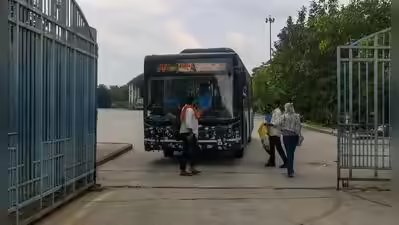
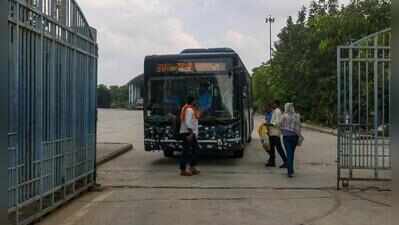
Gurgaon: The city bus service is set to get a boost. The first lot of 25 air-conditioned electric buses would be delivered “within seven days”, Gurgaon Metropolitan City Bus Limited (GMCBL) officials said on Thursday.The timeline was given by the concessionaire during a review meeting chaired by ministry of housing and urban affairs.The buses — part of the 100 e-buses sanctioned for the city under the Centre’s PM e-Bus Sewa Phase-I scheme — are expected to strengthen the city’s limited public transport network, which has long struggled with an ageing fleet and inadequate coverage.Officials said route planning for all 100 e-buses has already been completed. The first 25 buses will be deployed on priority corridors, with the remaining buses to be inducted in phases as they are delivered.GMCBL CEO Vishwajeet Chaudhary said, “The addition of new buses to the GMCBL fleet will provide a significant boost to public transport services in the city. It will enable us to cater to a larger passenger base, strengthen connectivity across more routes and further improve the accessibility, reliability and quality of public transport for the city’s commuters.”Officials said the induction of the first 25 buses will mark the beginning of the transition to an electric public transport fleet in the city, with the remaining buses expected to join the network in phases. “Once the full fleet is operational, it is expected to improve connectivity across residential sectors, industrial areas, metro stations and inter-city destinations while offering commuters a more reliable and environmentally friendly mode of transport,” the official said.The buses will be stationed at the Sector 10 depot, where the required infrastructure is ready. Preparations have also been completed at the Sector 48 depot, which has been developed to support e-bus operations.The planned network includes four trunk routes connecting major destinations such as Sector 2-Ghata village, city bus stand-NCI AIIMS Badsa, Sohna bus stand-city railway station and Manesar-city railway station.Other primary routes have also been identified to connect areas including Farrukhnagar, Bhondsi Jail, Sector 55/56 metro station, Badshapur, Guru Dronacharya metro station, Maruti Kunj, Cyber City and Manesar. The secondary network will improve connectivity between city railway station, Rajiv Chowk, Palam Vihar, Sector 10, HUDA City Centre metro station and other residential areas.Bus services have also been planned to connect the city with Delhi, including IMT Manesar-Dwarka Mor, IMT Manesar-Dwarka Sector 21 metro station and the city bus stand-Karol Bagh route. There are plans to run buses from the city bus stand to Ballabhgarh bus stand.The arrival of the buses is expected to improve services at a time when the city has fewer than 150 buses available for operations. GMCBL currently has around 200 buses in its fleet, but nearly 50 are operating in Faridabad following state govt directions. Many of the buses are old and experience frequent breakdowns, leading to unreliable services and limited connectivity across the city.The city last expanded its bus fleet in 2021, when eight air-conditioned CNG buses were inducted. Last year, Convergence Energy Services Limited (CESL) finalised a concessionaire under the PM e-Bus Sewa Phase-I initiative for the procurement, operation and maintenance of 200 electric buses, with 100 buses allocated to the city and 100 to Faridabad.In Feb this year, Haryana govt approved the procurement of electric buses for the city.