






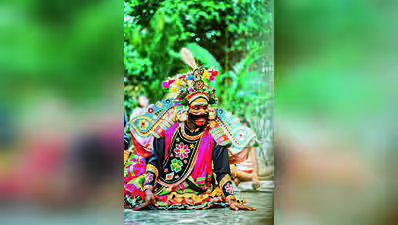
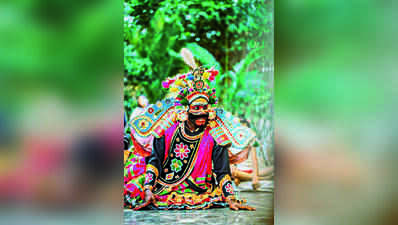
T here is a lot that Palani Murugan has done over the years to elevate therukoothu, the folk art form he inherited, from village streets to global stages, even partnering with British and French theatre icons in performances as well as masterclasses. But, says the 50-year-old artist from Purisai, that’s all he can do as one person. “The traditional arts need govt support. There is no govt-run art or cultural programme to provide a stage for performing artists. District organisers conduct a few programmes at their headquarters,” he says. “But that is not enough to help folk arts grow.” Palani, a fifth-generation performer, adds that the younger generation is not showing interest in learning therukoothu due to lack of opportunities and financial assistance.Eyal Isai Nataka Manram, the state’s cultural organization under the department of arts and culture, say artists, functions without a chairperson as no one has been appointed since the formation of the new TVK govt. Artists say the delay is disappointing. When TOI reached out to the Manram, an official said, “The timeline is not known”.Bharatanatyam dancer V P Dhananjayan, a 1990 Kalaimamani awardee, says the Manram has an executive board which artists are part of to discuss functions, events and schemes. “The last time there was active participation was in 2018. I was a member of the board. Since then, the board hasn’t convened for a general body meeting. The govt should reconstitute the council,” he says.In 2019, Madras high court pulled up the Manram, which confers the Kalaimamani — the state’s highest civilian awards to recognize outstanding artists for achievement in arts — for an eight-year lapse (2011-2018) in handing out the awards. The Manram cited “administrative and procedural” issues and presented 201 awards in 2019. The court invoked a 1995 govt directive requiring the awards to be announced every year on or before June 30. But the pattern continues. Awardees for 2021-2023 were announced in 2025.“At the state level, this is the only award artists receive. But it doesn’t happen regularly. TN is known for its art and culture, and yet artists are not celebrated,” says Dhananjayan.Palani says it is one of the best ways for folk artists from rural areas to gain exposure and get credit for their contribution to the industry.Conferring the awards is just one aspect of what the Manram is expected to do for the arts, say artists. Its other functions include financial assistance to indigent artists; family maintenance grant to the families of deceased famous artists; interstate cultural exchange programme; grants to folk artistes to buy musical instruments and costumes; production of dramas; and publication of books. But even that, say artists, is not happening regularly.“If the govt provides financial assistance to run a troupe or company it would increase the involvement of younger artists,” says Palani.Actor and theatre personality S Ve Sekar says that 20 years ago, drama troupes would perform 32 shows in 28 days; sometimes 120 in 90 days. “Today, a successful drama may get only half that because trying to get a space to perform is difficult. There’s corruption among private players and govt entities which is killing indie theatre. Earlier we had 150 sabhas and 140 drama troupes, this number has come down to 25 and 20,” he says.“The Hindu Religious and Charitable Endowments (HR&CE) department administers more than 1,000 temples. Through temples, they provide education, conduct workshops, and undertake medical initiatives. Why can’t the HR&CE department spend money on the folk arts and performing arts too?” says Palani. “The govt can promote whatever art is traditionally popular in each district. That way a systematic arts education can be guaranteed with a space.”DMK launched Chennai Sangamam in 2007, an annual open-air cultural festival held in Chennai during Pongal to celebrate Tamil folk arts, classical music, dance and cuisine. It was hosted by NGO Tamil Maiyam and the department of tourism and culture.Several folk artists welcomed the initiative. “Two years ago, I participated in Chennai Sangamam, my first big show, says Dharani P, a gaana artiste. “Usually, as gaana artists we don’t get to perform at events like that. There are few govt events and therefore very few artistes get showcased. Even private organisers don’t always welcome gaana artists so the opportunities for young and upcoming artists is limited in this field,” says the 30-year-old.“Today, artists no longer rely on govt events, preferring private dance and music organisations as they organize more cultural events,” says Sasmitta Arora, a Coimbatore-based Bharatanatyam performer and founder of Shankkaram.“We need a govt event that is not associated with a political party or private organisation so it can be conducted every year without interruption,” says Dhananjayan.A look backEyal Isai Nataka Manram was established in 1955 as the Tamil Nadu Sangeet Nataka Sangam to promote and preserve traditional Tamil arts. It was formally registered in 1956 and renamed in 1973.The Kalaimamani Awards have faced repeated disruptions to their annual cycle over the years. According to records cited by the Madras High Court, awards were not given in 1988-1989 and 1997, while an eight-year backlog accumulated between 2011 and 2018. In a 2019 judgement, the Madras High Court referred to a 1995 govt directive requiring the Kalaimamani awardees’ list to be announced every year on or before June 30 to avoid having to consider hundreds of artists at once. The cycle was disrupted again when the 2019 and 2020 awards were clubbed and announced in Feb 2021. More recently, awards for 2021, 2022 and 2023 were announced together in 2025