






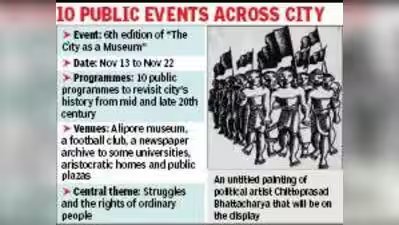
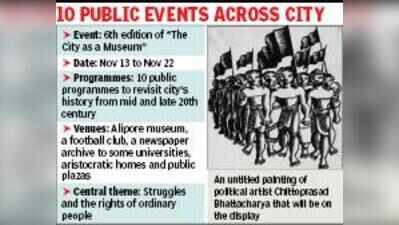
Kolkata: Various forms of artworks tracing Bengal’s art history around 1940s and 1990s will be on display at a 9-day exhibition at Alipore Museum, with 10 public programmes on various themes across the city, from Friday. The exhibition will showcase artworks, which are a part of ‘The City as a Museum’ series of Delhi Art Gallery (DAG)—a private art institution—based on French philosopher Henri Lefebvre’s concept of ‘The Right To The City.’The artworks will highlight themes of cultural resistance and ordinary people’s rights to the city. These artworks will be exhibited in the city for the first time.The festival will highlight how artists, poets, and film-makers have explored the theme through their works. Moreover, it will also examine artistic practices that articulated ordinary people’s claims amid the socio-political realities and struggles, before and after independence.The event will include an illustrated talk by art historian, Nandini Ghosh, on how modern art in Bengal responded to political strife, economic struggle and social upheaval.“Throughout the course of modern Indian art history, we have seen how moments of strife fuel artistic invention and expression, which is why histories of resistance are crucially tied to new art movements, collectives and solidarities,” Ashish Anand, the managing director and CEO of DAG, said. The edition, Anand said, focused on “this dialogue between invention and resistance.” “While some events are unique because they highlight significant and lesser-known sites and histories, such as a discussion on the Hungryalist movement or a session on ‘jibanmukhi gaan,’ and football’s role in Swadeshi and anti-communal struggles,” said Anand.Mrinal Sen’s “Calcutta 71” will also be screened at the Alipore Museum with insights from cultural critic, Supriya Chaudhuri.Sports historian Kausik Bandyopadhyay and 1981 Women’s World Cup captain Kuntala Ghosh Dastidar will also explore football’s cultural power at the Mohammedan Sporting Club. The lineup continues with “Theatre of the Streets” at Ranu Chhaya Mancha and musicologist Arka Chakraborty tracing jibanmukhi gaan at Presidency University, before concluding at Jadavpur University with “Dewal Likhon Nishedh,” featuring researcher Subhendu Dasgupta, Anupama Roy, and live-wall lettering by Sanjoy Kumar Mondal.