







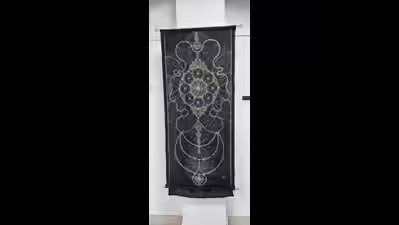
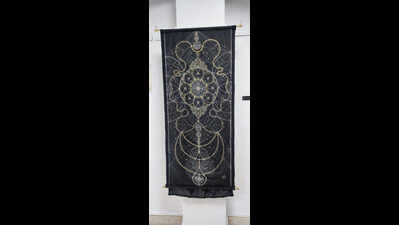
Not going anywhere this summer? Escape to different worlds through art. Say global art and the images that come to mind are those of European and North American artists. But displayed across the city are works by a multitude of artists from Portugal, Cuba, Northern Africa and Latin America.The Huruffiya art movement which started off in Muslim-majority countries combines Arabic calligraphy with modern abstract art. On display at the exhibition ‘Other Worlds of Art: Artworks from Latin America and Northern Africa’ at DakshinaChitra museum, Muthukadu, are works by Huruffiya artists Rachid Koraichi and Nja Mahdaoui from Northern Africa. “The artists study calligraphy until they become masters and then use the techniques to do contemporary artwork,” says curator Lilliam Boti, who also owns the entire collection at the exhibition. “We have 72 artworks in categories such as abstract art, conceptual art and portraiture,” says Lilliam. “Most of the artists have won national awards in their own countries.”Argentinian artist Carlos Alonso is an artist in his 90s, whose daughter was kidnapped during the military govt in Argentina. Many of his works are tributes to his lost daughter and political art, but at the exhibition is a rare work by Alonso of renowned tango singer Carlos Gardel. “Alonso was asked by the philatelic office of Argentina to create an image for a stamp for the anniversary of the birth of Carlos Gardel. And he said yes. This work is a stamp in Argentina,” says Lilliam.In the collection is a work by Tomie Ohtake, who went on a trip to Brazil to see her brother when she was in her 40s. “Brazil has the largest community of Japanese people outside of Japan and so there are millions of Japanese in Brazil,” says Lilliam. But then, the war started and Ohtake could never return to Japan, and so she decided to stay there. She also decided to become an artist and focus on art for the rest of her life. She’s credited for introducing a particular kind of abstract art in Brazil.”For Portuguese artist Joma Sipe, crystals are points of intersection where energy and light concentrate. Joma’s works – titled Upasika – are exhibited at the Theosophical Society, Adyar. Intricate black and white ink drawings with Swarovski crystals attached, his works are influenced by the writings of theosophists Helena Blavatsky and Annie Besant. “Nature, he says, is full of sacred geometric patterns invisible to the human eye. The elliptical chords of the DNA are visible only through a microscope. These patterns repeat and I use art and crystals to represent those energy fields.”